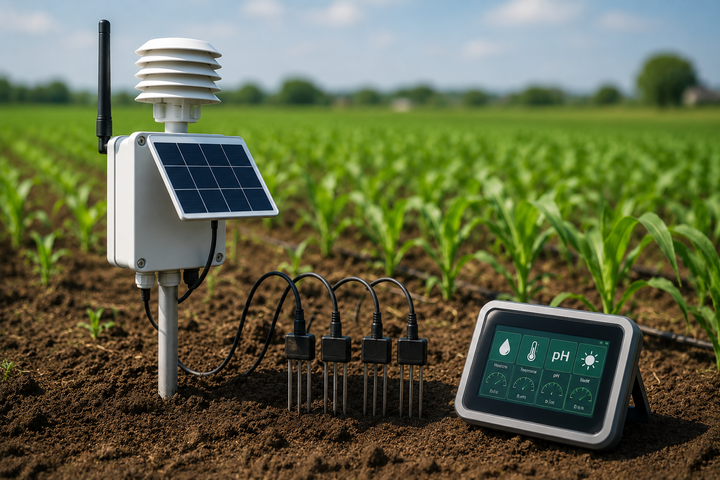
Agricultural Soil Sensors: Selection & Features Guide
Agricultural soil sensors have become an important tool in modern farming.
These devices help measure soil conditions and provide valuable information that supports crop management decisions. By collecting real-time data, soil sensors help farmers better understand moisture levels, temperature, nutrient availability, and other factors that influence plant growth.
As precision agriculture continues to expand, soil monitoring technologies are becoming increasingly common across farms of all sizes. Whether managing a small agricultural field or a large farming operation, understanding soil sensor features and selection criteria can improve decision-making and resource management.
This guide explains agricultural soil sensors, their types, key features, applications, selection factors, and future developments in simple and practical language.
Quick Facts About Agricultural Soil Sensors
| Feature | Description |
|---|---|
| Primary Purpose | Monitor soil conditions |
| Common Measurements | Moisture, temperature, pH, nutrients |
| Data Collection | Real-time monitoring |
| Installation | Surface or underground |
| Technology Type | Electronic sensing devices |
| Main Application | Precision agriculture |
| Connectivity Options | Wired or wireless |
| Key Benefit | Data-driven farming decisions |
What Are Agricultural Soil Sensors?
Agricultural soil sensors are devices designed to measure various soil properties that affect crop growth. They collect information directly from the soil and convert it into data that can be monitored and analyzed.
These sensors help track important conditions such as soil moisture, temperature, electrical conductivity, pH levels, and nutrient availability. Modern precision agriculture increasingly relies on such measurements to improve irrigation planning and crop management. Soil sensors are considered a core technology in smart agriculture systems because they help monitor moisture, temperature, pH, and nutrients in real time.
For example, a farmer growing vegetables can use soil moisture sensors to determine when irrigation is needed rather than relying solely on visual observation.
Understanding the Concept
Plants depend on soil conditions for healthy growth. If soil becomes too dry, too wet, too acidic, or nutrient-deficient, crop performance can be affected.
Agricultural soil sensors continuously measure these conditions and provide accurate information. Instead of relying on estimates, growers can make decisions based on actual field data.
This approach supports precision agriculture, where management practices are adjusted according to specific field conditions.
Why Are Soil Sensors Important in Modern Agriculture?
Modern farming increasingly focuses on efficiency, sustainability, and data-driven management.
Soil sensors help by:
- Monitoring field conditions continuously
- Supporting irrigation planning
- Tracking soil health indicators
- Identifying environmental changes
- Improving resource management
- Supporting precision agriculture strategies
Research highlights that soil moisture monitoring can improve irrigation scheduling and help avoid both under-watering and excessive irrigation.
Main Types of Agricultural Soil Sensors
Soil Moisture Sensors
These sensors measure the amount of water present in the soil.
They are among the most widely used agricultural sensors because water availability directly affects crop growth.
Soil Temperature Sensors
These sensors monitor soil temperature, which influences seed germination and root development.
Soil pH Sensors
pH sensors measure soil acidity or alkalinity.
Understanding pH helps farmers evaluate nutrient availability.
Electrical Conductivity (EC) Sensors
EC sensors measure the ability of soil to conduct electricity.
Electrical conductivity data can help assess salinity and nutrient conditions.
Soil Nutrient Sensors
These sensors help evaluate nutrient levels such as nitrogen, phosphorus, and potassium.
Multi-Parameter Sensors
Modern systems often combine several measurements into a single device.
Agricultural Soil Sensor Categories
| Sensor Type | Primary Measurement |
|---|---|
| Moisture Sensor | Water content |
| Temperature Sensor | Soil temperature |
| pH Sensor | Acidity and alkalinity |
| EC Sensor | Electrical conductivity |
| Nutrient Sensor | Soil nutrient levels |
| Multi-Parameter Sensor | Multiple variables |
Soil Moisture Sensor Technologies
Several technologies are used to measure soil moisture.
Resistive Sensors
These sensors estimate moisture using electrical resistance.
Capacitive Sensors
Capacitive sensors measure changes in soil dielectric properties and are widely used for moisture monitoring.
Tensiometers
Tensiometers measure soil water tension, indicating how strongly water is held by the soil.
Time Domain Reflectometry (TDR)
TDR sensors use electromagnetic signals to estimate moisture levels.
Soil Moisture Technology Comparison
| Technology | Measurement Method | Typical Application |
|---|---|---|
| Resistive | Electrical resistance | Basic monitoring |
| Capacitive | Dielectric measurement | Precision agriculture |
| Tensiometer | Water tension | Irrigation planning |
| TDR | Electromagnetic signals | Advanced monitoring |
Agricultural Soil Sensor Architecture
Understanding sensor architecture helps explain how these systems operate.
Sensing Element
The sensing component interacts directly with the soil.
Signal Processing Unit
Converts raw measurements into usable information.
Communication Module
Transfers collected data to monitoring systems.
Power System
Provides energy for sensor operation.
Data Platform
Stores and displays collected information.
How Agricultural Soil Sensors Work
Step 1: Sensor Placement
Sensors are installed at appropriate depths within the soil profile.
Step 2: Soil Measurement
The sensing element measures environmental conditions.
Step 3: Signal Generation
Measured values are converted into electronic signals.
Step 4: Data Processing
The system processes raw readings into meaningful information.
Step 5: Data Transmission
Information is transmitted to monitoring devices.
Step 6: Decision Support
Users analyze the data and adjust farming practices accordingly.
Key Features to Consider When Selecting Agricultural Soil Sensors
Measurement Accuracy
Accurate measurements are essential for reliable decision-making.
Sensor Durability
Agricultural environments can expose equipment to moisture, dust, and temperature variations.
Multi-Parameter Monitoring
Some sensors measure multiple variables simultaneously.
Wireless Connectivity
Wireless systems simplify data collection and monitoring.
Data Logging
Built-in data storage helps track long-term trends.
Ease of Installation
Simple installation reduces setup complexity.
Agricultural Soil Sensor Feature Comparison
| Feature | Importance |
|---|---|
| Accuracy | High |
| Durability | High |
| Connectivity | High |
| Data Storage | Moderate to High |
| Ease of Installation | Moderate |
| Multi-Parameter Capability | High |
How Do Farmers Select the Right Soil Sensor?
Selection depends on several factors.
Crop Type
Different crops have different monitoring requirements.
Soil Type
Sensor performance can vary depending on soil characteristics.
Irrigation Strategy
Water management goals influence sensor selection.
Monitoring Objectives
Users should identify which soil parameters are most important.
Field Size
Larger fields may require broader monitoring coverage.
Agricultural experts often recommend selecting sensors based on the management decision they support rather than collecting unnecessary data.
Benefits and Advantages
Better Irrigation Management
Soil moisture data helps improve irrigation timing.
Improved Resource Efficiency
Data-driven decisions support efficient resource use.
Enhanced Crop Monitoring
Continuous monitoring provides valuable field insights.
Early Problem Detection
Changes in soil conditions can be identified quickly.
Support for Precision Agriculture
Sensors help guide field-specific management decisions.
Long-Term Soil Understanding
Historical data reveals seasonal and long-term trends.
Real-World Applications
Row Crop Farming
Used for irrigation scheduling and soil monitoring.
Greenhouse Production
Supports controlled growing environments.
Fruit Orchards
Monitors root-zone moisture conditions.
Vegetable Production
Helps optimize irrigation decisions.
Research Farms
Provides detailed environmental data.
Smart Farming Systems
Integrated with advanced agricultural technologies.
Agricultural Applications Comparison
| Application | Sensor Benefit |
|---|---|
| Irrigation Management | Water optimization |
| Crop Monitoring | Real-time field insights |
| Soil Health Assessment | Condition tracking |
| Precision Agriculture | Data-driven decisions |
| Research Projects | Detailed measurements |
| Greenhouse Farming | Controlled monitoring |
Environmental Considerations
Agricultural soil sensors support more efficient management of natural resources.
Water Conservation
Accurate moisture monitoring helps optimize irrigation scheduling.
Reduced Resource Waste
Data-based decisions can help reduce unnecessary inputs.
Sustainable Farming Practices
Monitoring technologies support precision agriculture approaches.
Soil Health Awareness
Continuous monitoring provides better visibility into soil conditions.
Industry Standards and Safety
Agricultural sensors are generally designed to operate under demanding environmental conditions.
Environmental Protection Ratings
Many field sensors include weather-resistant enclosures.
Measurement Calibration
Proper calibration helps maintain accuracy.
Installation Guidelines
Correct installation improves measurement reliability.
Data Quality Management
Consistent monitoring practices help maintain trustworthy data.
Common Challenges and Practical Solutions
| Challenge | Practical Solution |
|---|---|
| Incorrect Installation | Follow installation guidelines |
| Sensor Calibration Issues | Perform regular calibration |
| Soil Variability | Install sensors at representative locations |
| Communication Problems | Verify connectivity systems |
| Environmental Exposure | Use protected sensor housings |
| Data Interpretation | Review monitoring trends regularly |
Best Practices for Soil Sensor Deployment
- Install sensors at appropriate root depths.
- Calibrate sensors when required.
- Monitor readings consistently.
- Protect cables and communication equipment.
- Use multiple monitoring locations when necessary.
- Maintain equipment according to recommendations.
Key Facts About Agricultural Soil Sensors
- Soil moisture sensors are among the most widely used agricultural monitoring tools.
- Modern sensors can measure moisture, temperature, pH, nutrients, and conductivity.
- Wireless monitoring is becoming increasingly common in precision agriculture.
- Multi-parameter sensors reduce the need for multiple devices.
- Sensor technology continues to evolve with improved accuracy and connectivity.
Future Trends and Industry Insights
Smart Agriculture Integration
Sensors are increasingly integrated with digital farming systems.
Wireless Networks
Advanced connectivity supports remote monitoring.
Artificial Intelligence Applications
Future systems may provide predictive recommendations.
Improved Sensor Accuracy
Ongoing research focuses on enhanced measurement performance.
Multi-Sensor Platforms
Integrated monitoring systems continue to expand.
Frequently Asked Questions
What are agricultural soil sensors?
Devices used to measure soil conditions such as moisture, temperature, pH, and nutrients.
Why are soil sensors important?
They provide data that supports informed agricultural decisions.
What is a soil moisture sensor?
A sensor that measures water content within the soil.
What does an EC sensor measure?
Electrical conductivity, which can provide information about salinity and nutrient conditions.
How do pH sensors help agriculture?
They help monitor soil acidity and alkalinity.
Can one sensor measure multiple parameters?
Yes, multi-parameter sensors can measure several conditions simultaneously.
Where are soil sensors installed?
Typically within the crop root zone.
Do soil sensors require calibration?
Many sensors require calibration to maintain accuracy.
How do wireless soil sensors work?
They transmit collected data through communication networks.
What is precision agriculture?
A farming approach that uses data to improve decision-making and resource management.
Conclusion
Agricultural soil sensors have become an essential part of modern precision agriculture. By providing accurate information about soil moisture, temperature, pH, nutrients, and conductivity, these technologies help support better farming decisions and improved resource management.
As sensor technology continues to advance, future systems are expected to provide greater accuracy, enhanced connectivity, and deeper integration with smart agriculture platforms. For growers seeking a better understanding of field conditions, agricultural soil sensors represent one of the most valuable monitoring tools available today.