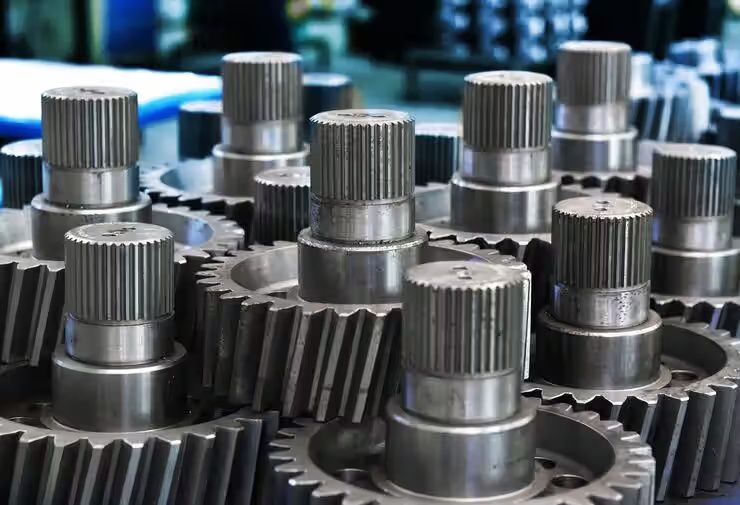
Gear manufacturing machines are specialized industrial machines used to produce gears—mechanical components that transmit motion and power between rotating shafts. These machines shape gear teeth with high precision so that motion is transferred smoothly, efficiently, and reliably across mechanical systems.
The need for gear manufacturing machines arose as machinery became more complex and speed, load, and durability requirements increased. Early gears were produced using manual cutting methods, which limited accuracy and consistency. As industrial systems evolved, dedicated machines were developed to control tooth geometry, spacing, and surface quality with much higher precision.
Today, gear manufacturing machines exist to support industries where accuracy, repeatability, and load-bearing performance are essential. From small precision gears to large industrial gear sets, these machines form the backbone of motion transmission technology.
Importance: Why Gear Manufacturing Machines Matter Today
Gear manufacturing machines play a vital role in modern engineering because gears directly influence efficiency, noise levels, reliability, and energy transfer.
Why this topic matters today:
-
Precision motion control: Accurate gear teeth ensure smooth power transmission
-
Industrial reliability: Well-manufactured gears reduce vibration and wear
-
High-load performance: Industrial equipment relies on gears that withstand stress
-
Energy efficiency: Precise gearing minimizes power losses
-
Automation compatibility: Modern machines support consistent high-volume production
These machines affect mechanical engineers, production planners, quality inspectors, maintenance teams, and industrial designers. They help solve challenges related to misalignment, uneven load distribution, excessive noise, and premature mechanical failure.
Industries such as automotive, aerospace, industrial machinery, robotics, wind energy, and rail transport depend heavily on high-quality gears produced using advanced manufacturing equipment.
Recent Updates: Industry Trends and Developments (2024–2025)
In the past year, gear manufacturing technology has advanced significantly, driven by automation, digital control, and demand for higher accuracy.
| Year | Development or Trend | Industrial Impact |
|---|---|---|
| 2024 | Increased use of CNC-controlled gear machines | Improved repeatability and flexibility |
| 2024 | Advanced cutting tool materials | Longer tool life and improved surface finish |
| 2025 | Integration of inline inspection systems | Faster detection of tooth profile deviations |
| 2025 | Greater automation in gear handling | Reduced manual errors and improved consistency |
Recent developments also include better simulation of gear tooth contact, improved grinding techniques for hardened gears, and compact modular machines suitable for flexible production lines.
Laws, Standards, and Regulatory Influence
Gear manufacturing machines operate within established engineering and safety standards to ensure product reliability and workplace safety.
Common standards and regulations include:
-
ISO gear standards: Define tooth geometry, accuracy grades, and tolerance limits
-
AGMA standards: Widely used guidelines for gear design, quality, and inspection
-
Workplace machinery safety regulations: Address guarding, emergency stops, and operator protection
-
Quality management systems: Require documented processes and traceable inspection results
Many industries require gears to meet specific accuracy grades depending on application, making compliance with these standards critical for manufacturers.
Key Gear Manufacturing Processes
Gear manufacturing machines are designed around specific processes, each suited to different gear types and accuracy requirements.
Major gear production processes include:
-
Gear hobbing: Continuous cutting process suitable for spur and helical gears
-
Gear shaping: Uses a reciprocating cutter for internal and external gears
-
Gear milling: Flexible method for small batches and special profiles
-
Gear grinding: High-precision finishing process for hardened gears
-
Gear honing and lapping: Improves surface finish and tooth contact patterns
| Process | Primary Purpose | Typical Application |
|---|---|---|
| Hobbing | High productivity | Automotive and industrial gears |
| Shaping | Internal gears | Gearboxes and compact assemblies |
| Grinding | High accuracy | Aerospace and precision machinery |
| Honing | Noise reduction | High-speed gear systems |
Each process contributes differently to accuracy, surface quality, and production efficiency.
Precision Engineering and Accuracy Factors
Precision is the defining characteristic of gear manufacturing machines. Small deviations in gear geometry can significantly affect system performance.
Key accuracy factors include:
-
Tooth profile accuracy
-
Lead and pitch consistency
-
Surface roughness
-
Concentricity and alignment
-
Heat-treatment distortion control
Modern gear machines often include automatic compensation systems, temperature control, and real-time measurement to maintain consistent accuracy throughout production.
Tools and Learning Resources for Better Understanding
Understanding gear manufacturing machines is supported by a range of technical and educational resources.
Helpful learning resources include:
-
Mechanical engineering textbooks on machine design and kinematics
-
Gear technology handbooks and reference guides
-
Industrial manufacturing journals
-
Training manuals for CNC gear machines
-
Metrology guides for gear inspection
Reference tools commonly used:
-
Gear tooth measurement charts
-
Accuracy grade comparison tables
-
Contact pattern analysis diagrams
-
Inspection and quality audit checklists
These resources help bridge the gap between theoretical design and practical manufacturing.
Frequently Asked Questions
What is the main role of gear manufacturing machines?
They produce gears with precise tooth geometry to ensure smooth and reliable power transmission.
Why is gear accuracy so important?
Inaccurate gears can cause noise, vibration, energy loss, and premature mechanical failure.
Which industries rely most on gear manufacturing machines?
Automotive, industrial machinery, aerospace, renewable energy, robotics, and rail transport.
How does automation improve gear manufacturing?
Automation increases consistency, reduces human error, and supports continuous quality monitoring.
Are gears inspected after manufacturing?
Yes. Gears typically undergo dimensional checks, profile analysis, and surface quality evaluation.
Conclusion
Gear manufacturing machines are a cornerstone of modern mechanical engineering. By enabling precise control over gear geometry, surface quality, and consistency, these machines ensure reliable motion transmission across countless industrial applications.
As industries demand higher efficiency, lower noise, and greater durability, gear manufacturing technology continues to evolve through automation, advanced tooling, and integrated inspection. Understanding these machines provides valuable insight into how precision engineering supports the smooth operation of modern machinery.