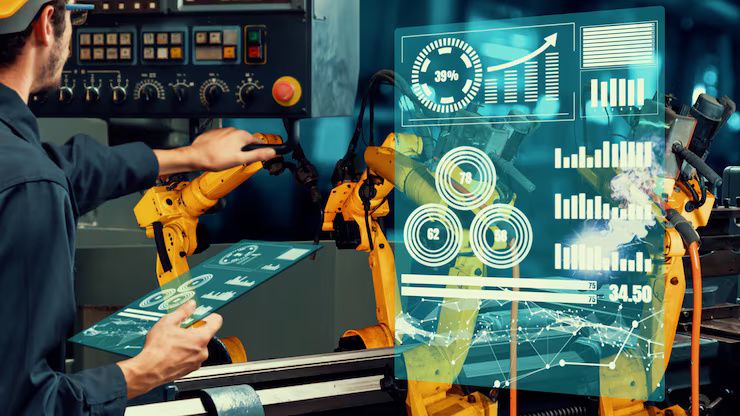
AI-based quality monitors are advanced inspection systems that use machine vision, artificial intelligence algorithms, and automated control systems to detect defects, measure dimensions, and verify product quality in manufacturing environments. These systems capture images or sensor data from products and analyze them in real time to identify inconsistencies that may not be visible to the human eye.
Traditional quality control methods relied heavily on manual inspection or basic sensors. While effective to some extent, these approaches often struggle with high-speed production lines, complex patterns, or microscopic defects. AI-based monitoring systems were developed to address these challenges by combining visual data with intelligent decision-making capabilities.
In modern smart factories, AI-powered inspection systems are becoming an essential component of industrial automation and precision manufacturing.
Why AI-Based Quality Monitoring Matters Today
Quality control is critical in industries where product accuracy directly affects performance, safety, and brand reputation. AI-based monitoring systems are increasingly important because they enhance both speed and reliability.
Key reasons this technology matters:
-
Higher detection accuracy: Identifies micro-defects and subtle surface variations
-
Real-time inspection: Evaluates products instantly during production
-
Reduced human error: Minimizes inconsistencies in manual inspections
-
Process optimization: Provides data insights for continuous improvement
-
Scalability: Handles high-volume manufacturing efficiently
Industries benefiting from AI-based quality monitors include automotive manufacturing, electronics production, pharmaceuticals, food processing, aerospace components, packaging, and heavy machinery. In each of these sectors, small defects can lead to operational issues or compliance challenges.
How Machine Vision Works in Quality Monitoring
Machine vision is the core technology behind AI-based quality monitors. It uses cameras, lighting systems, and image-processing algorithms to analyze visual data.
Basic working process:
-
Image Capture: High-resolution cameras capture images of products as they move along a production line.
-
Pre-Processing: The system enhances contrast, filters noise, and isolates important features.
-
AI Analysis: Machine learning models compare captured data against reference standards.
-
Decision Output: The system flags defects, categorizes issues, or approves products.
-
Feedback Loop: Data is stored and used to improve future detection accuracy.
Unlike rule-based systems that rely on fixed parameters, AI-driven models learn from historical defect data. This improves their ability to detect variations in shape, color, texture, alignment, and dimensional consistency.
Core Components of AI-Based Quality Monitors
AI inspection systems combine multiple hardware and software elements working together.
| Component | Function | Industrial Role |
|---|---|---|
| Industrial Cameras | Capture detailed images | Surface and shape inspection |
| Lighting Systems | Enhance feature visibility | Accurate defect identification |
| AI Processing Unit | Analyzes data using algorithms | Pattern recognition |
| Sensors | Detect position and movement | Synchronization with production |
| Interface Panel | Displays results and alerts | Operator monitoring |
These components form an integrated inspection environment that operates continuously within automated production lines.
Recent Developments (2024–2025)
AI-based quality monitoring technology has advanced rapidly in the past year, especially in terms of processing speed and model intelligence.
| Year | Trend or Update | Impact |
|---|---|---|
| 2024 | Edge computing integration | Faster on-site data analysis |
| 2024 | Improved deep learning models | Better detection of complex defects |
| 2025 | 3D vision inspection systems | Enhanced dimensional measurement |
| 2025 | Predictive quality analytics | Early detection of production drift |
One significant development has been the integration of AI monitors into Industry 4.0 environments, where systems communicate with other machines to adjust parameters automatically when defects exceed defined thresholds.
Regulations and Quality Standards
AI-based quality monitors operate within industrial and quality management frameworks to ensure reliability and compliance.
Relevant standards include:
-
ISO 9001: Quality management systems requiring consistent inspection procedures
-
ISO 13485: Medical device manufacturing quality standards
-
IATF 16949: Automotive quality management requirements
-
FDA manufacturing guidelines (US): Applicable in regulated industries
These standards emphasize traceability, documentation, and validated inspection processes. AI-based monitoring systems support compliance by generating digital inspection records and audit trails.
Industrial Applications of AI-Based Quality Monitoring
AI-powered inspection systems are used in a variety of manufacturing scenarios.
Common applications include:
-
Surface defect detection in metal and plastic components
-
Printed circuit board inspection in electronics manufacturing
-
Bottle and packaging seal verification
-
Dimensional accuracy checks for mechanical parts
-
Label verification and print quality monitoring
By automating these tasks, manufacturers improve production reliability while maintaining high throughput.
Benefits for Industrial Accuracy
Accuracy is the defining strength of AI-based quality monitors.
Key accuracy advantages:
-
Micron-level detection capability
-
Consistent evaluation under varying lighting conditions
-
Reduced false-positive rates with trained AI models
-
Continuous improvement through data feedback
Unlike manual inspection, which may vary between operators, AI systems maintain consistent performance across shifts and production cycles.
Challenges and Considerations
Despite their advantages, AI-based quality monitors require thoughtful implementation.
-
Proper dataset training is essential for reliable defect recognition
-
Lighting and camera positioning affect detection performance
-
Regular calibration ensures measurement precision
-
Data storage and cybersecurity policies must be considered
Organizations typically conduct pilot testing and validation before full-scale deployment.
FAQs
What makes AI-based quality monitors different from traditional inspection systems?
They use machine learning models to analyze visual data rather than fixed rule-based criteria.
Can AI systems replace human inspectors?
They complement human oversight by handling repetitive tasks and improving consistency.
Are AI monitors suitable for small manufacturing setups?
Yes, scalable systems are available for both small and large production environments.
How accurate are AI-based inspection systems?
Accuracy depends on training quality, hardware configuration, and calibration, but they are highly reliable for repeatable tasks.
Do these systems improve production efficiency?
Yes, real-time detection reduces rework and prevents defective batches from progressing further in the process.
Conclusion
AI-based quality monitors represent a significant advancement in industrial inspection technology. By combining machine vision, automation, and intelligent algorithms, these systems enhance accuracy, speed, and consistency in manufacturing environments.
As industries continue moving toward smart manufacturing ecosystems, AI-powered inspection will remain a key component of reliable production processes. Understanding how these systems function, how they integrate with automation, and how they support regulatory compliance helps organizations leverage their full potential for industrial accuracy and quality assurance.