Solar panel assembly machines are specialized industrial systems used in photovoltaic (PV) module manufacturing. These machines automate the process of assembling solar cells into fully functional solar panels ready for installation in residential, commercial, and utility-scale projects.
As global renewable energy adoption accelerates, advanced solar panel manufacturing equipment plays a central role in ensuring efficiency, quality control, and production scalability.
Modern photovoltaic module production lines integrate precision robotics, automation systems, and quality inspection technologies to meet high-performance energy standards.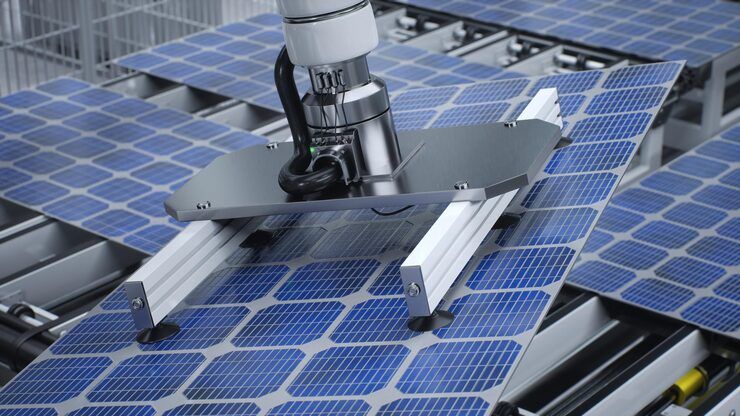
Solar panels are built from photovoltaic cells that convert sunlight into electricity. These cells must be carefully interconnected, laminated, framed, and tested before becoming finished modules.
Manual assembly methods are not suitable for large-scale production due to the precision required and the growing demand for renewable energy systems. Solar panel assembly machines were developed to:
-
Increase manufacturing speed
-
Improve electrical efficiency consistency
-
Reduce material waste
-
Ensure structural durability
-
Maintain international quality standards
A typical solar panel production line includes multiple automated stations, each responsible for a specific stage in the photovoltaic module manufacturing process.
Key production stages include:
• Solar Cell Sorting
• Stringing and Tabbing
• Layup Process
• Laminating
• Framing
• Junction Box Installation
• Electroluminescence (EL) Testing
• Final Quality Inspection
These processes rely on specialized solar module production equipment designed for precision handling and long-term reliability.
Manufacturing Workflow: Step-by-Step Overview
Solar panel assembly follows a structured workflow to ensure electrical performance and structural integrity.
Solar Cell Sorting
Before assembly, photovoltaic cells are sorted based on electrical characteristics such as voltage and current. Sorting ensures uniform performance across the final module.
Stringing and Tabbing
In this stage, solar cells are interconnected using automated stringing machines. Conductive ribbons are soldered onto the cells to form strings. Precision soldering ensures minimal resistance loss.
Layup Process
Cell strings are arranged on a glass substrate along with encapsulation materials such as EVA (ethylene vinyl acetate). Automated layup machines position components accurately to maintain alignment.
Laminating
The lamination process uses heat and vacuum pressure to bond the layers together. Laminators remove air pockets and seal the panel to protect against moisture and environmental damage.
Framing and Junction Box Installation
Aluminum frames are attached to provide mechanical strength. A junction box is installed to connect the panel to external electrical systems.
Testing and Inspection
Electroluminescence testing systems detect microcracks or hidden defects in solar cells. Flash testing measures power output under simulated sunlight conditions.
High-precision solar panel laminating machines and automated EL inspection systems are critical for maintaining module reliability and long-term performance.
Equipment Types in Solar Panel Manufacturing
Different types of machines are used across the photovoltaic module production line.
Solar Cell Stringer Machines
Used to interconnect individual cells with high soldering accuracy.
Automatic Layup Machines
Arrange glass, EVA, cell strings, and backsheet layers in precise alignment.
Vacuum Laminators
Seal and encapsulate modules under controlled temperature and pressure conditions.
Framing Machines
Attach aluminum frames securely and consistently.
Junction Box Potting Systems
Apply insulation materials and secure electrical connections.
Electroluminescence (EL) Testers
Detect microcracks and electrical inconsistencies.
Flash Testers
Simulate sunlight exposure to measure voltage, current, and output power.
| Equipment Type | Primary Function | Importance |
|---|---|---|
| Stringer Machine | Cell interconnection | Electrical continuity |
| Laminator | Encapsulation | Moisture protection |
| EL Tester | Defect detection | Quality assurance |
| Flash Tester | Performance testing | Power verification |
| Framing Machine | Structural assembly | Durability |
This structured equipment chain ensures consistent output and compliance with photovoltaic industry standards.
Importance: Why Solar Panel Assembly Machines Matter Today
Global investment in renewable energy infrastructure has increased significantly in recent years. Utility-scale solar farms, rooftop systems, and commercial solar installations require reliable module production at scale.
Solar panel assembly machines contribute to:
-
Increased production capacity
-
Improved energy conversion efficiency
-
Reduced manufacturing errors
-
Lower long-term operational risk
-
Enhanced module durability
Automated photovoltaic manufacturing systems enable high-volume production while maintaining strict quality benchmarks.
Manufacturers, energy developers, policymakers, and sustainability planners all rely on advanced solar module production equipment to support climate and energy goals.
As solar adoption expands, demand for high-efficiency module assembly systems continues to rise globally.
Recent Updates and Industry Trends in 2025
In 2025, the solar manufacturing industry continues to evolve rapidly.
Several manufacturers have introduced AI-powered inspection systems capable of detecting microscopic defects during the lamination stage. These systems improve early fault identification and reduce production waste.
High-efficiency cell technologies such as TOPCon and HJT (heterojunction) have influenced assembly line upgrades. Production equipment is being adapted to handle thinner wafers and higher-efficiency cells introduced in late 2024 and early 2025.
Automation integration has expanded, with robotic material handling systems reducing manual intervention in module production facilities.
In mid-2025, several countries expanded domestic solar manufacturing incentives to strengthen local production capacity and reduce import dependency. This has increased investment in advanced photovoltaic assembly lines.
Energy efficiency standards for solar modules have also tightened in various markets, requiring manufacturers to upgrade flash testing and inspection systems.
Laws and Policies Affecting Solar Panel Manufacturing
Solar panel assembly operations are influenced by environmental, safety, and trade regulations.
In the United States, manufacturing compliance includes:
-
Occupational Safety and Health Administration (OSHA) workplace standards
-
Environmental Protection Agency (EPA) environmental compliance
-
Inflation Reduction Act incentives supporting domestic solar production
In the European Union, photovoltaic modules must meet CE certification requirements and environmental directives related to electronic waste management (WEEE Directive).
In India, solar manufacturing aligns with:
-
Ministry of New and Renewable Energy (MNRE) guidelines
-
Production Linked Incentive (PLI) schemes for domestic manufacturing
-
Bureau of Indian Standards (BIS) certification requirements
Regulatory frameworks ensure product reliability, environmental compliance, and worker safety throughout the manufacturing process.
Compliance with photovoltaic certification standards is essential for module acceptance in global energy markets.
Tools and Resources for Solar Manufacturing
Manufacturers and engineers rely on digital and analytical tools to optimize production lines.
Helpful tools include:
• PV Module Simulation Software – Predict electrical performance outcomes.
• Production Line Monitoring Systems – Track throughput and efficiency.
• Quality Control Checklists – Standardize inspection protocols.
• Energy Yield Calculators – Estimate module output in different climates.
• ERP Systems for Manufacturing – Manage inventory and workflow integration.
• Certification Documentation Templates – Support compliance audits.
Data analytics platforms are increasingly used to track defect rates and optimize equipment calibration in real time.
FAQs About Solar Panel Assembly Machines
What is the main function of a solar panel assembly machine?
It automates the process of assembling photovoltaic cells into fully functional solar modules with consistent quality.
Why is lamination important in solar module production?
Lamination protects cells from moisture, mechanical stress, and environmental damage, ensuring long-term durability.
How are defects detected during manufacturing?
Electroluminescence testing systems identify microcracks and electrical inconsistencies before final approval.
Are solar panel manufacturing lines fully automated?
Most modern facilities use high levels of automation, although some manual quality checks may still be included.
How do regulations impact production?
Standards and certification requirements influence material selection, testing procedures, and safety practices.
Conclusion
Solar panel assembly machines form the backbone of modern photovoltaic manufacturing. From automated stringing to high-precision lamination and digital inspection systems, these technologies enable scalable and reliable solar module production.
Industry trends in 2025 highlight increasing automation, improved defect detection, and adaptation to next-generation cell technologies. Regulatory compliance and sustainability initiatives continue shaping equipment upgrades and operational standards.
As renewable energy adoption accelerates worldwide, advanced solar panel manufacturing equipment remains critical to delivering efficient, durable, and certified photovoltaic modules for global energy infrastructure.