Hydraulic Press Brake Machines: Enterprise Operation Tips
Hydraulic press brake machines are among the most important pieces of equipment in modern metal fabrication.
These machines are used to bend sheet metal into precise shapes and angles for industries such as automotive manufacturing, construction, aerospace, industrial equipment production, and metal processing.
As manufacturing standards continue to advance, enterprises require equipment that delivers accuracy, repeatability, and productivity. Hydraulic press brakes help achieve these goals by providing controlled bending force and precise positioning capabilities.
Understanding how hydraulic press brake machines work, their components, operational requirements, and maintenance practices can help manufacturing facilities improve efficiency, product quality, and operational consistency.
Quick Facts About Hydraulic Press Brake Machines
| Feature | Description |
|---|---|
| Primary Function | Sheet metal bending |
| Power Source | Hydraulic system |
| Common Industries | Manufacturing, construction, automotive |
| Control Type | CNC or conventional controls |
| Material Types | Steel, aluminum, stainless steel |
| Production Environment | Fabrication workshops and factories |
| Key Advantage | Precision bending |
| Typical Applications | Panels, brackets, enclosures, frames |
What Is a Hydraulic Press Brake Machine?
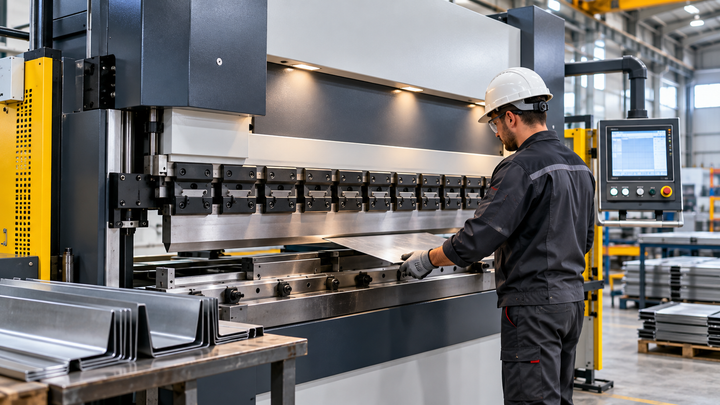
A hydraulic press brake is a machine tool designed to bend sheet metal by applying controlled force through a punch and die system.
The machine uses hydraulic cylinders to move a ram downward, pressing metal into a die and creating the desired bend angle. Hydraulic systems provide smooth force control and allow manufacturers to achieve consistent results across multiple production runs.
For example, metal enclosures used in electrical cabinets, industrial equipment housings, and machine frames are often produced using hydraulic press brake technology.
Understanding the Working Principle
The operation of a hydraulic press brake is based on controlled force application.
Basic Process
- Sheet metal is positioned on the machine.
- The operator selects the required bending parameters.
- Hydraulic cylinders move the ram downward.
- The punch presses the material into the die.
- The desired bend angle is achieved.
- The ram returns to its original position.
The accuracy of this process depends on machine setup, tooling quality, material characteristics, and operator expertise.
Hydraulic Press Brake Architecture
Understanding machine architecture helps explain how hydraulic press brakes achieve precision.
Machine Frame
The frame provides structural support and maintains rigidity during operation.
Hydraulic System
The hydraulic system generates and controls bending force.
Ram Assembly
The ram moves vertically and applies force to the sheet metal.
Punch and Die Tooling
Tooling determines the shape and angle of the bend.
Back Gauge System
The back gauge positions material accurately before bending.
CNC Controller
Modern machines use CNC controls to automate bending sequences and improve consistency.
Main Components of Hydraulic Press Brake Machines
| Component | Function |
|---|---|
| Machine Frame | Structural support |
| Hydraulic Cylinders | Generate bending force |
| Ram | Transfers force to material |
| Punch | Creates bending action |
| Die | Forms bend geometry |
| Back Gauge | Positions sheet metal |
| Hydraulic Pump | Supplies hydraulic pressure |
| Control System | Manages machine operation |
Types of Hydraulic Press Brake Machines
Conventional Hydraulic Press Brakes
Operate using manual or basic control systems.
CNC Hydraulic Press Brakes
Use computerized controls for automated precision bending.
Synchronized Hydraulic Press Brakes
Provide improved ram synchronization and accuracy.
Multi-Axis Press Brakes
Support complex bending operations with advanced positioning capabilities.
Heavy-Duty Hydraulic Press Brakes
Designed for thicker materials and larger industrial applications.
Hydraulic Press Brake Capacity Comparison
| Capacity Category | Typical Application |
|---|---|
| Light-Duty | Small metal components |
| Medium-Duty | General fabrication |
| Heavy-Duty | Industrial manufacturing |
| Large-Format | Structural fabrication |
| Enterprise Production | High-volume manufacturing |
How Hydraulic Press Brake Machines Work
Step 1: Material Preparation
The sheet metal is inspected and prepared for bending.
Step 2: Tool Selection
Appropriate punch and die tooling are selected.
Step 3: Machine Programming
Bending parameters are entered into the control system.
Step 4: Material Positioning
The back gauge aligns the material accurately.
Step 5: Bending Operation
Hydraulic cylinders apply controlled force.
Step 6: Quality Verification
Finished parts are inspected for dimensional accuracy.
Common Materials Processed
| Material | Typical Use |
|---|---|
| Mild Steel | Industrial components |
| Stainless Steel | Equipment fabrication |
| Aluminum | Lightweight structures |
| Copper | Electrical applications |
| Galvanized Steel | Construction components |
Enterprise Operation Tips
Standardize Machine Setup Procedures
Consistent setup procedures help reduce errors and improve production quality.
Use Appropriate Tooling
Selecting the correct punch and die combination improves bend accuracy and tooling life.
Maintain Accurate Material Data
Material thickness and properties should be verified before production begins.
Optimize Production Scheduling
Grouping similar jobs can improve operational efficiency.
Implement Quality Control Checks
Routine inspections help identify potential issues early in the production process.
Train Operators Continuously
Operator knowledge plays a significant role in machine performance and product quality.
CNC Press Brake Advantages
Improved Accuracy
CNC systems help maintain consistent bend angles.
Faster Setup
Stored programs reduce setup time for repeat jobs.
Better Repeatability
Automated positioning improves production consistency.
Production Efficiency
Automated sequences help increase productivity.
Reduced Material Waste
Accurate bending minimizes rework and scrap.
Production Workflow Example
| Production Stage | Objective |
|---|---|
| Material Inspection | Verify specifications |
| Tool Selection | Match tooling to job |
| Programming | Configure machine parameters |
| Positioning | Align material accurately |
| Bending | Form desired shape |
| Inspection | Confirm quality standards |
Noise and Operating Environment
Hydraulic press brake performance can be influenced by operating conditions.
Temperature Control
Stable temperatures help maintain hydraulic system performance.
Clean Work Areas
Dust and debris should be minimized around machine components.
Adequate Lighting
Good visibility supports safe operation and quality control.
Floor Stability
Machines should be installed on suitable industrial flooring.
Ventilation
Proper ventilation helps maintain a comfortable working environment.
Safety and Usage Considerations
Follow Operating Procedures
Standard operating procedures support safe machine use.
Use Protective Equipment
Appropriate safety equipment should be worn during operation.
Verify Tooling Installation
Tooling should be secured correctly before production.
Inspect Safety Systems
Emergency stops and protective systems should be checked regularly.
Avoid Unauthorized Adjustments
Only trained personnel should perform machine adjustments.
Industry Standards and Manufacturing Requirements
Hydraulic press brake machines are commonly used in environments where quality control and manufacturing consistency are important.
Precision Manufacturing
Accurate bending supports dimensional consistency.
Production Documentation
Manufacturing records help maintain process control.
Equipment Inspection
Routine inspections support machine reliability.
Preventive Maintenance
Scheduled maintenance helps reduce unexpected downtime.
Environmental Considerations
Energy Efficiency
Modern hydraulic systems focus on improved energy management.
Material Utilization
Accurate bending helps reduce material waste.
Hydraulic Fluid Management
Proper fluid handling supports environmental responsibility.
Equipment Longevity
Routine maintenance can extend machine lifespan.
Common Challenges and Practical Solutions
| Challenge | Practical Solution |
|---|---|
| Inconsistent Bend Angles | Verify tooling and machine settings |
| Material Positioning Errors | Calibrate back gauge system |
| Hydraulic Pressure Variations | Inspect hydraulic components |
| Excessive Downtime | Follow preventive maintenance schedules |
| Tool Wear | Replace worn tooling promptly |
| Production Delays | Improve scheduling and workflow planning |
Hydraulic Press Brake Maintenance Schedule
| Maintenance Task | Frequency | Purpose |
|---|---|---|
| Hydraulic Fluid Inspection | Daily | Monitor fluid condition |
| Tool Inspection | Daily | Verify tooling quality |
| Machine Cleaning | Daily | Remove debris |
| Hydraulic System Check | Weekly | Maintain performance |
| Back Gauge Inspection | Weekly | Ensure positioning accuracy |
| Lubrication Check | Monthly | Reduce component wear |
| System Calibration | Periodically | Maintain precision |
| Comprehensive Inspection | Annually | Evaluate overall condition |
Best Practices for Enterprise Operations
Maintain Tooling Records
Tracking tooling usage supports maintenance planning.
Monitor Machine Performance
Performance monitoring helps identify operational trends.
Standardize Production Processes
Consistent procedures improve manufacturing quality.
Implement Preventive Maintenance
Routine maintenance reduces downtime risks.
Verify Material Specifications
Accurate material data supports reliable bending results.
Utilize CNC Programming Features
Advanced controls can improve production efficiency.
Expert Insights
Manufacturing specialists often emphasize that machine precision depends on the combined performance of tooling, hydraulic systems, operator knowledge, and maintenance practices.
Enterprises that focus on preventive maintenance, process standardization, and operator training typically achieve more consistent production outcomes and improved equipment utilization.
Key Facts About Hydraulic Press Brake Machines
- Hydraulic press brakes are widely used in metal fabrication industries.
- CNC systems have significantly improved bending accuracy and repeatability.
- Back gauge systems play a major role in positioning precision.
- Tooling selection directly influences bend quality.
- Preventive maintenance supports long-term machine reliability.
Future Trends and Industry Insights
Smart Manufacturing Integration
Press brakes are increasingly integrated into digital manufacturing environments.
Advanced CNC Controls
Control systems continue to become more sophisticated.
Improved Automation
Automation supports productivity and consistency.
Predictive Maintenance
Monitoring technologies may help identify maintenance needs before failures occur.
Enhanced Production Analytics
Data-driven manufacturing continues to expand across fabrication facilities.
Frequently Asked Questions
What is a hydraulic press brake machine?
A machine used to bend sheet metal using controlled hydraulic force.
What industries use hydraulic press brakes?
Manufacturing, construction, automotive, aerospace, and industrial fabrication industries.
What is the function of a back gauge?
It positions sheet metal accurately before bending.
Why is CNC technology important?
It improves accuracy, repeatability, and production efficiency.
What materials can be bent?
Mild steel, stainless steel, aluminum, copper, and galvanized steel.
Why is tooling selection important?
Tooling directly affects bend quality and accuracy.
How often should maintenance be performed?
Routine inspections and preventive maintenance should follow a structured schedule.
What factors influence bend accuracy?
Tooling condition, machine setup, material properties, and operator expertise.
What is preventive maintenance?
Planned maintenance designed to reduce unexpected downtime.
What future trends are expected?
Automation, predictive maintenance, advanced controls, and smart manufacturing integration.
Conclusion
Hydraulic press brake machines remain a critical technology in modern metal fabrication. Their ability to deliver precise, repeatable sheet metal bending supports industries ranging from construction and automotive manufacturing to industrial equipment production.
By focusing on proper machine setup, operator training, tooling management, preventive maintenance, and process standardization, enterprises can improve productivity, maintain quality, and maximize equipment performance. As manufacturing technology continues to evolve, hydraulic press brakes are expected to become even more intelligent, connected, and efficient.