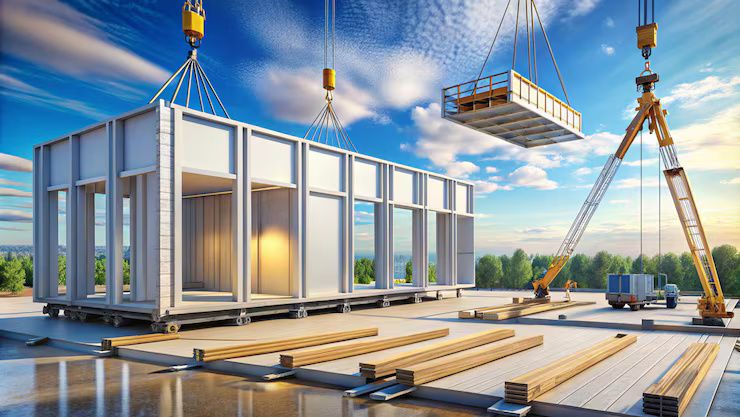
Prefabricated structures are buildings or structural components that are manufactured in a controlled factory environment and then transported to the construction site for assembly. Unlike conventional construction, where most work happens on-site, prefabrication shifts a significant portion of the process to off-site facilities.
These structures exist to address long-standing challenges in construction, such as long project timelines, inconsistent quality, labor dependency, and weather-related delays. By producing standardized components under controlled conditions, prefabricated construction improves consistency, efficiency, and predictability.
Prefabricated structures may include complete modules, wall panels, floor systems, roof sections, or structural frames. Once delivered to the site, these components are assembled to form residential, commercial, industrial, or infrastructure buildings
Importance: Why Prefabricated Structures Matter Today
Prefabricated construction has become increasingly important due to urban expansion, infrastructure demand, and the need for efficient building solutions.
Why this topic matters today:
-
Faster project completion: Parallel off-site manufacturing and on-site preparation
-
Consistent quality: Factory-controlled production reduces variability
-
Reduced site disruption: Less noise, waste, and congestion at construction sites
-
Resource efficiency: Optimized material usage and reduced rework
-
Scalability: Suitable for repetitive and large-scale building programs
Prefabricated structures affect architects, engineers, developers, urban planners, infrastructure agencies, and sustainability professionals. They help solve problems related to construction delays, labor shortages, inconsistent workmanship, and inefficient material use.
Recent Updates: Industry Trends and Developments (2024–2025)
Over the past year, prefabricated construction has continued to evolve with advancements in modular design and process integration.
| Year | Development or Trend | Impact on Construction |
|---|---|---|
| 2024 | Increased adoption of volumetric modules | Faster assembly of multi-story buildings |
| 2024 | Improved digital design coordination | Better alignment between design and manufacturing |
| 2025 | Use of lightweight composite panels | Easier transport and faster installation |
| 2025 | Emphasis on sustainable prefabrication | Lower waste and improved environmental performance |
Recent projects in 2024–2025 show growing use of prefabrication in healthcare facilities, education buildings, housing developments, and industrial warehouses. Governments and developers increasingly recognize its role in meeting tight delivery schedules.
Laws, Standards, and Regulatory Influence
Prefabricated structures are subject to the same safety and performance requirements as conventional buildings, along with additional manufacturing and transportation considerations.
Common regulatory and standard frameworks include:
-
Building codes and structural standards: Ensure load-bearing capacity and safety
-
Fire and life safety regulations: Govern materials, exits, and fire resistance
-
Transportation regulations: Control size, weight, and movement of prefabricated modules
-
Quality management standards: Require traceability and inspection during manufacturing
In many regions, authorities provide dedicated guidelines for modular construction to ensure compliance while encouraging innovation. Certification and inspection processes often occur both at the factory and on-site.
Modular Design Principles in Prefabricated Structures
Modular design is the foundation of prefabricated construction. It focuses on dividing a building into repeatable units that can be efficiently manufactured and assembled.
Key modular design principles include:
-
Standardization: Repeating dimensions and connection details
-
Interoperability: Modules fit together without modification
-
Structural continuity: Load paths align across assembled units
-
Service integration: Electrical and mechanical systems planned in advance
-
Flexibility: Modules allow future expansion or reconfiguration
Good modular design balances standardization with architectural variety, allowing functional and visually diverse buildings.
Construction Methods Used in Prefabrication
Prefabricated structures can be produced using several construction methods, depending on application and scale.
Common prefabrication methods include:
-
Volumetric modular construction: Fully finished three-dimensional modules
-
Panelized construction: Flat wall, floor, and roof panels assembled on-site
-
Hybrid systems: Combination of modules and panels
-
Structural frame prefabrication: Pre-made steel or concrete frames
| Method | Key Feature | Typical Use |
|---|---|---|
| Volumetric | High factory completion | Residential buildings |
| Panelized | Flexible design | Commercial structures |
| Hybrid | Balanced approach | Multi-use developments |
| Frame-based | Structural efficiency | Industrial facilities |
Each method offers different advantages in terms of speed, flexibility, and transport efficiency.
Accuracy and Quality Control in Prefabricated Construction
Accuracy is a major advantage of prefabricated structures due to factory-controlled conditions.
Key accuracy factors include:
-
Precision cutting and assembly equipment
-
Controlled environmental conditions
-
Standardized inspection procedures
-
Digital design-to-production alignment
Factory-based production allows tighter tolerances than many traditional site-based processes, reducing alignment issues during assembly and improving overall building performance.
Tools and Learning Resources
Understanding prefabricated structures is supported by a range of technical and educational resources.
Helpful learning resources include:
-
Construction engineering textbooks
-
Modular building design guides
-
Industry research papers on off-site construction
-
Government publications on modern construction methods
-
Training manuals for modular assembly
Reference tools commonly used:
-
Modular coordination grids
-
Structural load calculation tables
-
Transportation and lifting planning templates
-
Quality inspection checklists
These resources help professionals plan, execute, and evaluate prefabricated construction projects effectively.
Frequently Asked Questions
What types of buildings use prefabricated structures?
Residential housing, schools, hospitals, offices, industrial buildings, and temporary facilities.
Are prefabricated buildings structurally durable?
Yes. When designed and manufactured correctly, they meet the same structural standards as conventional buildings.
How does prefabrication affect construction timelines?
It significantly shortens timelines by allowing off-site manufacturing and on-site preparation to occur simultaneously.
Can prefabricated structures be customized?
Yes. Modular systems allow variation in layout, finishes, and configuration within standardized frameworks.
Do prefabricated structures support sustainability goals?
They reduce material waste, improve energy efficiency, and minimize site disruption.
Conclusion
Prefabricated structures represent a significant shift in how buildings are designed and constructed. By combining modular design principles with factory-based manufacturing, they offer faster delivery, consistent quality, and efficient use of resources.
As construction demands grow and project timelines tighten, prefabricated construction continues to gain importance across residential, commercial, and industrial sectors. Understanding its methods, regulatory context, and design principles provides valuable insight into one of the most transformative approaches in modern construction.