Chemical Mixing Equipment Guide: Types, Working and Uses Explained
Chemical mixing equipment refers to industrial machines and systems designed to combine liquids, powders, gases, or other materials to produce a uniform mixture or controlled chemical formulation.
These systems use mechanical agitation, high-shear forces, fluid circulation, or static mixing elements to achieve the required blending, dispersion, dissolution, and homogenization.
Chemical mixing equipment is used in industries such as chemicals, pharmaceuticals, paints, coatings, petrochemicals, food processing, and water treatment. Equipment selection depends on material properties, viscosity, production capacity, mixing requirements, and operating conditions.
Quick Facts About Chemical Mixing Equipment
The following table summarizes the essential characteristics of industrial chemical mixing systems.
Feature | Details |
|---|---|
Equipment Category | Industrial processing machinery |
Primary Function | Combining and homogenizing materials |
Main Materials | Liquids, powders, gases, suspensions, and pastes |
Common Equipment | Agitators, static mixers, high-shear mixers, and powder mixers |
Operating Methods | Mechanical agitation, fluid circulation, and shear forces |
Common Configurations | Batch and continuous processing |
Main Components | Mixing vessel, motor, shaft, impeller, and control system |
Important Parameters | Viscosity, density, temperature, and mixing speed |
Common Industries | Chemical, pharmaceutical, petrochemical, and manufacturing |
Main Applications | Blending, emulsification, dispersion, dissolution, and suspension |
What Is Chemical Mixing Equipment?
Chemical mixing equipment is a category of industrial machinery used to combine different substances and achieve specific physical or chemical properties. It helps distribute ingredients evenly, maintain consistent material composition, and prepare formulations for subsequent manufacturing processes.
Depending on the application, a chemical mixer may process two or more liquids, incorporate solid powders into liquids, disperse particles, or combine materials with different viscosities.
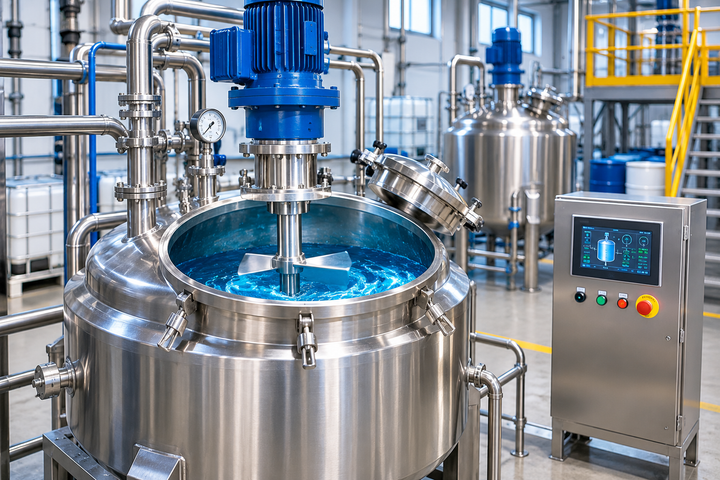
For example, a chemical manufacturing facility may use an industrial mixing tank to combine liquid ingredients, maintain a controlled temperature, and produce a consistent chemical formulation. A high-shear mixer may be used when finer particle dispersion or emulsification is required.
These systems are available in different designs, including tank-mounted agitators, inline mixers, powder blending machines, and specialized mixing vessels.
Why Chemical Mixing Equipment Matters in Industrial Processing
Chemical production often involves materials with different densities, viscosities, particle sizes, and chemical properties. Combining these materials requires controlled mixing conditions to achieve the intended product characteristics.
Without suitable mixing equipment, manufacturers may experience uneven ingredient distribution, incomplete dissolution, inconsistent product quality, or unwanted material separation.
Industrial mixing equipment supports several important processing requirements:
Material uniformity: Distributes ingredients throughout a mixture to achieve consistent composition.
Process control: Helps regulate mixing speed, temperature, and operating conditions.
Particle dispersion: Breaks down agglomerates and distributes solid particles throughout liquids.
Emulsion formation: Helps combine immiscible liquids into dispersed systems.
Chemical reaction support: Improves contact between reactants in suitable processes.
Production consistency: Provides repeatable mixing conditions across manufacturing batches.
Material handling: Supports the processing of liquids, powders, suspensions, and viscous substances.
The required mixing intensity varies according to the process. Simple liquid blending may need moderate circulation, while emulsification and fine dispersion often require higher mechanical energy.
How Does Chemical Mixing Equipment Work?
Chemical mixing equipment works by creating controlled movement within materials. The movement may come from rotating impellers, mechanical blades, high-speed rotors, stationary mixing elements, or other specialized mechanisms.
The operating process generally involves the following stages.
1. Material Preparation and Loading
Raw materials are prepared according to the formulation and introduced into the mixing system.
Depending on the equipment design, materials may enter through a tank opening, feeding system, dosing arrangement, or connected pipeline.
2. Mechanical Agitation or Fluid Movement
The mixer generates movement through rotating components or controlled fluid flow.
In tank-based systems, an impeller moves material around the vessel. In static mixers, fixed internal elements divide and redirect flowing materials to promote blending.
3. Material Distribution and Dispersion
The movement helps distribute ingredients throughout the mixture. Depending on the application, it can also suspend solid particles, break down agglomerates, or create smaller liquid droplets.
4. Temperature and Process Regulation
Some chemical mixing operations require temperature control because mixing and chemical reactions can generate or absorb heat.
Jacketed vessels, internal coils, and external heat exchangers may be incorporated to maintain the required operating conditions.
5. Mixing Quality Evaluation
The resulting mixture is assessed according to the process requirements. Evaluation may involve checking composition, viscosity, temperature, particle distribution, or other relevant product properties.
6. Material Discharge or Transfer
After the required mixing conditions are achieved, the processed material is transferred to storage vessels, reaction equipment, filling systems, or subsequent production stages.
The following table illustrates a typical batch mixing workflow.
Stage | Equipment or Process | Main Activity |
|---|---|---|
1 | Feeding system | Introduces raw materials |
2 | Mixing vessel | Holds the materials |
3 | Agitator or mixer | Generates material movement |
4 | Temperature control | Regulates thermal conditions |
5 | Monitoring system | Tracks operating parameters |
6 | Discharge arrangement | Transfers the finished mixture |
Actual workflows vary according to the formulation, equipment architecture, and whether the process operates in batches or continuously.
Main Types of Chemical Mixing Equipment
Chemical mixing machinery is classified according to its mixing mechanism, material compatibility, and processing requirements. The following equipment categories cover common industrial applications.
1. Industrial Agitators
Industrial agitators use rotating shafts and impellers to create circulation inside a mixing vessel. They are commonly used for blending liquids, suspending solids, and maintaining uniform material distribution.
The impeller design determines the flow pattern and mixing intensity.
Common agitator configurations include:
Propeller agitators: Generate axial flow and support liquid circulation.
Turbine agitators: Produce radial or mixed flow for blending and dispersion.
Pitched-blade agitators: Combine axial and radial flow for general-purpose mixing.
Anchor agitators: Move close to vessel walls and are suitable for more viscous materials.
Helical ribbon agitators: Create circulation in highly viscous materials and pastes.
Advantages:
Suitable for different liquid viscosities.
Available in multiple impeller configurations.
Can be integrated with temperature-controlled vessels.
Supports batch processing and continuous circulation applications.
2. High-Shear Mixers
High-shear mixers use mechanical energy to generate intense velocity differences within materials. A common design is the rotor-stator mixer, which contains a rapidly rotating rotor positioned inside a stationary stator.
Material passes through the rotor-stator assembly, where strong shear forces help break down droplets, particles, and agglomerates.
These mixers are commonly used for emulsification, homogenization, powder wetting, and fine dispersion.
Advantages:
Produces fine dispersions.
Supports emulsification processes.
Helps incorporate powders into liquids.
Suitable for specialized formulations requiring intensive mixing.
3. Static Mixers
Static mixers use fixed internal elements installed inside a pipe or processing channel. They have no rotating shafts or mechanically driven mixing blades.
As materials flow through the mixer, the stationary elements divide, redirect, and recombine the streams to improve distribution.
Static mixers are frequently used in continuous chemical processing, additive blending, and inline reagent mixing.
Advantages:
No moving mixing components.
Compact inline configuration.
Relatively low mechanical maintenance.
Suitable for continuous processing.
Can support liquid-liquid and gas-liquid mixing applications.
Their performance depends on flow conditions, material viscosity, and the pressure drop across the mixing elements.
4. Inline Dynamic Mixers
Inline dynamic mixers combine materials inside a pipeline using mechanically driven mixing components.
Unlike static mixers, they contain moving elements powered by a motor. Depending on the design, these may include rotating blades, impellers, or rotor-stator assemblies.
They are used when continuous processing requires adjustable mixing intensity or additional mechanical energy.
Advantages:
Supports continuous material processing.
Allows adjustment of mixing intensity in suitable designs.
Can handle different formulation requirements.
Integrates with automated production lines.
5. Ribbon Blenders
Ribbon blenders are horizontal powder mixing machines that use rotating helical ribbons inside a trough-shaped vessel.
The ribbons move materials in different directions, creating circulation and promoting ingredient distribution throughout the mixing chamber.
They are commonly used for dry chemical powders, granules, and selected solid-solid mixtures.
Advantages:
Suitable for dry powder blending.
Supports relatively large material batches.
Provides continuous movement within the mixing chamber.
Can be adapted for different powder characteristics.
6. Paddle Mixers
Paddle mixers use rotating blades or paddles to move materials inside a mixing chamber. Their configurations vary according to the material consistency and mixing requirements.
They are used for blending powders, granules, semi-solid materials, and selected wet mixtures.
Advantages:
Supports different solid material characteristics.
Provides mechanical movement across the mixing chamber.
Suitable for powder and granule blending.
Available in horizontal and vertical configurations.
7. Planetary Mixers
Planetary mixers use one or more mixing tools that rotate around their own axes while also moving around a central axis inside the vessel.
This combined movement helps reach different areas of the mixing chamber and is useful for processing viscous materials.
They are commonly used for adhesives, sealants, specialty chemicals, pastes, and other thick formulations.
Advantages:
Suitable for high-viscosity materials.
Provides extensive mixing coverage.
Supports paste and compound preparation.
Can be configured with vacuum processing capabilities.
8. Kneader Mixers
Kneader mixers use specially shaped mechanical blades to apply compression, folding, and shearing forces to thick materials.
They are designed for applications where conventional liquid agitators may not provide sufficient material movement.
Common applications include polymer compounds, rubber processing, adhesives, and specialty chemical formulations.
Advantages:
Handles highly viscous materials.
Supports intensive material incorporation.
Suitable for pastes and dense compounds.
Available with different blade and vessel configurations.
Chemical Mixing Equipment Type Comparison
Different mixer designs produce different flow patterns and mechanical forces. The following comparison summarizes their main operating characteristics.
Equipment Type | Mixing Mechanism | Suitable Materials | Common Applications |
|---|---|---|---|
Industrial Agitator | Rotating impeller | Liquids and suspensions | Liquid blending |
High-Shear Mixer | Rotor-stator shear | Liquids, emulsions, and dispersions | Homogenization |
Static Mixer | Fixed internal elements | Flowing liquids and gases | Inline blending |
Inline Dynamic Mixer | Mechanically driven mixing | Liquids and selected viscous materials | Continuous processing |
Ribbon Blender | Rotating helical ribbons | Powders and granules | Dry chemical blending |
Paddle Mixer | Rotating paddles | Powders and semi-solids | Material blending |
Planetary Mixer | Combined rotational movement | Viscous liquids and pastes | Adhesives and sealants |
Kneader Mixer | Compression and shearing | Dense pastes and compounds | Polymer processing |
Main Components of Chemical Mixing Equipment
Industrial chemical mixers contain several mechanical, electrical, and process-related components. Their arrangement depends on whether the system uses a mixing vessel, an inline configuration, or a specialized powder-processing design.
The following table explains the main components of a typical tank-based chemical mixing system.
Component | Function | Technical Description |
|---|---|---|
Mixing Vessel | Contains materials | Holds the substances during processing |
Electric Motor | Provides mechanical power | Drives the mixing mechanism |
Gearbox | Controls mechanical output | Adjusts torque and rotational speed |
Mixing Shaft | Transfers rotational movement | Connects the drive to the impeller |
Impeller | Generates fluid movement | Creates circulation and mixing forces |
Baffles | Interrupt rotational flow | Reduce unwanted swirling and improve circulation |
Mechanical Seal | Restricts material leakage | Seals the rotating shaft opening |
Temperature Control System | Regulates process temperature | Uses jackets or coils for heating and cooling |
Sensors | Monitor operating conditions | Measure temperature, pressure, or other variables |
Control Panel | Manages equipment operation | Provides monitoring and control functions |
Not every mixing machine contains all these components. For example, a static mixer does not require a motor, gearbox, rotating shaft, or mechanical seal.
Chemical Mixing Equipment vs Blending Equipment
Chemical mixing and blending are related operations, but their technical requirements can differ depending on the materials and intended outcome.
Mixing generally refers to a broad range of operations involving the combination and distribution of different phases or substances. Blending commonly describes the distribution of ingredients to achieve a consistent composition.
Comparison Factor | Chemical Mixing Equipment | Blending Equipment |
|---|---|---|
Main Purpose | Combines and processes materials | Distributes ingredients uniformly |
Material Types | Liquids, gases, powders, and suspensions | Commonly powders, granules, and liquids |
Operating Forces | Agitation, shear, and fluid movement | Mechanical movement and circulation |
Common Equipment | Agitators, high-shear mixers, and static mixers | Ribbon blenders and paddle blenders |
Process Requirements | May involve dispersion, dissolution, or reactions | Primarily focuses on ingredient distribution |
Applications | Chemical formulations and emulsions | Dry powders and ingredient mixtures |
The distinction is not absolute. Many industrial machines perform both mixing and blending functions.
Applications of Chemical Mixing Equipment Across Industries
Chemical mixing systems are used in manufacturing processes that require controlled material combinations, consistent formulations, and repeatable processing conditions.
1. Chemical Manufacturing
Chemical manufacturing facilities use mixing equipment to combine raw materials, prepare chemical formulations, and support selected chemical reactions.
Common applications include:
Liquid chemical blending.
Chemical additive incorporation.
Acid and alkali solution preparation.
Suspension preparation.
Intermediate product formulation.
The equipment must be compatible with the chemical properties and operating conditions of the materials being processed.
2. Pharmaceutical Manufacturing
Pharmaceutical production uses specialized mixing systems to prepare formulations with controlled ingredient distribution.
Applications include powder blending, liquid formulation preparation, suspension production, and ointment processing.
Mixing equipment in this industry may require sanitary construction, controlled operating environments, documented processing parameters, and validated cleaning procedures.
3. Paints, Coatings, and Inks
Paint and coating production requires equipment capable of incorporating pigments, resins, solvents, additives, and other formulation ingredients.
High-shear mixers and dispersers are commonly used to distribute pigments and reduce agglomerates. Tank agitators help maintain material uniformity during different processing stages.
4. Petrochemical and Petroleum Processing
Petrochemical facilities use mixing systems for blending process streams, incorporating additives, and preparing selected chemical formulations.
Inline static mixers are useful in continuous pipelines, while tank agitators support batch blending and material circulation.
5. Food and Beverage Processing
Food processing operations use industrial mixing equipment for liquid blending, emulsification, ingredient incorporation, and preparation of viscous formulations.
Common applications include:
Syrup preparation.
Beverage ingredient blending.
Sauce production.
Emulsion preparation.
Ingredient suspension.
Equipment selection must consider hygiene, material compatibility, and cleaning requirements.
6. Water and Wastewater Treatment
Water treatment facilities use mixing equipment to distribute treatment chemicals throughout water streams.
Applications include reagent blending, pH adjustment, coagulant distribution, and preparation of chemical dosing solutions.
Inline mixers and tank agitators are selected according to flow conditions, treatment requirements, and chemical characteristics.
7. Adhesives and Sealant Manufacturing
Adhesive and sealant production often involves materials with high viscosity and complex rheological properties.
Planetary mixers and kneader mixers are used to incorporate resins, fillers, polymers, and other formulation ingredients.
Vacuum-capable mixing systems may also be used to reduce entrapped air when the formulation requires it.
8. Cosmetics and Personal Care Manufacturing
Cosmetic production uses mixing equipment to prepare creams, lotions, gels, emulsions, and other formulations.
High-shear mixers help disperse ingredients and form emulsions, while anchor and planetary mixers support the processing of more viscous materials.
Common Chemical Mixing Challenges and Solutions
Chemical mixing processes can experience operational difficulties when equipment design does not match the material properties or processing requirements.
The following table outlines common challenges and suitable engineering approaches.
Common Challenge | Possible Cause | Recommended Approach |
|---|---|---|
Uneven mixing | Inadequate circulation or unsuitable impeller | Review impeller design and vessel geometry |
Excessive foaming | Air entrainment and high agitation | Adjust mixing conditions and equipment configuration |
Poor powder dispersion | Inadequate wetting or particle agglomeration | Evaluate powder feeding and dispersion methods |
Temperature fluctuations | Insufficient heat transfer | Review jacket or heat exchanger capacity |
Material separation | Incompatible formulation or inadequate stabilization | Evaluate formulation and mixing conditions |
Excessive vibration | Mechanical imbalance or improper installation | Inspect alignment and rotating components |
Leakage | Seal wear or unsuitable sealing materials | Inspect seals and material compatibility |
Inconsistent batch quality | Variable operating conditions | Standardize process parameters and monitoring |
Some problems may require changes to the formulation rather than adjustments to the mixer. Equipment performance and material behavior should therefore be evaluated together.
How to Choose Chemical Mixing Equipment
Selecting suitable chemical mixing equipment requires understanding the material characteristics, production method, and desired mixing result. A machine designed for low-viscosity liquids may not perform effectively with dense pastes or concentrated powder mixtures.
The following selection factors help organize the evaluation.
Selection Factor | What to Evaluate | Why It Matters |
|---|---|---|
Material Type | Liquids, powders, gases, or pastes | Determines the mixing mechanism |
Viscosity | Flow resistance of the material | Influences impeller and motor requirements |
Batch Capacity | Required processing volume | Determines vessel dimensions |
Mixing Objective | Blending, dispersion, emulsification, or suspension | Determines equipment configuration |
Production Method | Batch or continuous operation | Influences system architecture |
Temperature Requirements | Heating, cooling, or temperature stability | Determines thermal control requirements |
Chemical Compatibility | Corrosion and material resistance | Influences construction materials |
Mixing Intensity | Low, moderate, or high shear | Determines mechanical design |
Cleaning Requirements | Product changeover and cleaning procedures | Affects vessel and equipment construction |
Automation Requirements | Sensors, controls, and monitoring | Determines control system integration |
Understand Material Viscosity
Viscosity is one of the most important factors in mixer selection. Low-viscosity liquids generally circulate more easily, while highly viscous materials require greater torque and specialized impeller configurations.
For example, a propeller agitator may be appropriate for a low-viscosity liquid, whereas a helical ribbon or planetary mixer may be more suitable for thick formulations.
Determine the Required Mixing Result
The required result should guide the selection of the mixing mechanism.
General liquid blending may require an industrial agitator.
Fine dispersion may require a high-shear mixer.
Continuous pipeline blending may require a static mixer.
Dry powder homogenization may require a ribbon blender.
Dense paste processing may require a kneader or planetary mixer.
Evaluate Chemical Compatibility
Vessel materials, shafts, seals, and impellers must be compatible with the substances being processed.
Depending on the chemical environment, construction may involve stainless steel, specialized alloys, or suitable polymeric materials. Material selection should account for concentration, temperature, corrosion potential, and cleaning chemicals.
Limitations of Chemical Mixing Equipment
Although industrial mixing systems support many manufacturing operations, their performance is influenced by equipment design, process conditions, and material characteristics.
Several limitations should be considered:
Energy requirements: High-shear and intensive mixing processes can require substantial mechanical power.
Heat generation: Mechanical energy can increase material temperature and affect temperature-sensitive formulations.
Equipment wear: Shafts, seals, bearings, and impellers experience mechanical stress during operation.
Limited material compatibility: Some chemicals require specialized vessel materials and sealing arrangements.
Cleaning complexity: Complex internal geometries can make cleaning and product changeover more difficult.
Scale-up challenges: Mixing performance may change when moving from laboratory equipment to industrial production volumes.
Process sensitivity: Changes in viscosity, density, or ingredient concentration can influence mixing behavior.
An appropriate equipment design should account for these limitations during process development and engineering evaluation.
Chemical Mixing Equipment Safety and Industry Standards
Chemical mixing operations may involve corrosive substances, flammable liquids, combustible powders, pressure, rotating machinery, and temperature variations. Equipment design and operating procedures must address the hazards associated with the specific materials and process.
Several recognized standards are relevant to industrial mixing installations.
IEC 60204-1: Safety of Machinery – Electrical Equipment of Machines
This standard addresses electrical equipment used in machinery, including electrical control systems, wiring, protective measures, and related machine electrical requirements.
IEC 60079: Explosive Atmospheres
The IEC 60079 series addresses equipment and protection requirements for explosive atmospheres. It is relevant when chemical processing environments may contain flammable gases, vapors, or combustible dusts.
ASME Boiler and Pressure Vessel Code
The ASME Boiler and Pressure Vessel Code is relevant when chemical mixing installations include pressure vessels or other equipment within its scope.
NFPA 30: Flammable and Combustible Liquids Code
This code addresses fire protection and safety considerations associated with flammable and combustible liquid handling and storage.
Equipment operators should also follow material safety information, process-specific risk assessments, approved operating procedures, and appropriate protective measures.
Chemical Mixing Equipment Maintenance Best Practices
Regular maintenance helps preserve equipment reliability, mixing performance, and operational consistency. Maintenance requirements depend on the mixer design, processed materials, and operating environment.
Inspect Mechanical Components
Examine shafts, impellers, bearings, couplings, and mechanical seals for wear, damage, leakage, or abnormal movement.
Monitor Motor and Gearbox Performance
Check operating temperatures, unusual noise, vibration, and other signs of mechanical stress. Follow the equipment manufacturer's inspection and lubrication requirements.
Check Vessel Condition
Inspect the mixing vessel, internal surfaces, welds, and connections for corrosion, deposits, or material degradation.
Verify Mixing Performance
Review process results for changes in mixing time, product uniformity, dispersion quality, and operating consistency.
Maintain Temperature Control Systems
Inspect jackets, coils, heat exchangers, and associated connections for leaks, blockages, and reduced thermal performance.
Review Control and Monitoring Systems
Verify that sensors, temperature indicators, speed controls, alarms, and other monitoring components operate as intended.
Follow Cleaning Procedures
Use approved cleaning methods appropriate for the processed chemicals and equipment construction. Cleaning procedures should prevent incompatible substances from contacting each other during product changeovers.
Future Trends in Chemical Mixing Equipment
Chemical mixing technology continues to develop through improvements in automation, process monitoring, energy management, and equipment design.
Automated Mixing Systems
Modern mixing installations increasingly use programmable controllers and automated operating sequences to manage mixing speed, temperature, ingredient addition, and processing time.
Automation can support consistent operating conditions and reduce the need for manual adjustments.
Advanced Process Monitoring
Sensors and digital monitoring systems can provide information about temperature, pressure, motor load, viscosity-related indicators, and other process variables.
These measurements help operators evaluate equipment performance and identify abnormal operating conditions.
Energy-Efficient Mixer Designs
Equipment development increasingly focuses on improving fluid movement and reducing unnecessary mechanical energy consumption. Impeller geometry, motor efficiency, and process-specific mixer configurations are important design considerations.
Continuous Chemical Processing
Continuous mixing systems are used in processes where materials can be combined and processed through connected pipelines or production equipment.
Static mixers and inline dynamic mixers support these arrangements by integrating mixing functions directly into process flow paths.
Improved Computational Design
Computational fluid dynamics (CFD) is used in engineering studies to evaluate fluid movement, circulation patterns, shear distribution, and mixing vessel behavior.
These tools can support equipment development and process scale-up by helping engineers understand how design changes may influence mixing performance.
Frequently Asked Questions About Chemical Mixing Equipment
1. What is chemical mixing equipment used for?
Chemical mixing equipment is used to combine liquids, powders, gases, and other materials into consistent mixtures or formulations. Common operations include blending, dispersion, emulsification, dissolution, and suspension preparation.
2. What are the main types of chemical mixing equipment?
Common types include industrial agitators, high-shear mixers, static mixers, inline dynamic mixers, ribbon blenders, paddle mixers, planetary mixers, and kneader mixers. Each type is designed for particular material properties and mixing requirements.
3. What is the difference between a static mixer and a dynamic mixer?
A static mixer uses fixed internal elements to combine flowing materials without moving components. A dynamic mixer uses mechanically driven components, such as rotating blades or impellers, to generate mixing forces.
4. Which mixer is suitable for high-viscosity chemicals?
Planetary mixers, anchor agitators, helical ribbon mixers, and kneader mixers are commonly used for high-viscosity materials. The appropriate design depends on the material's flow behavior, batch size, and required mixing intensity.
5. What materials are used to manufacture chemical mixing equipment?
Common construction materials include stainless steel, carbon steel, specialized corrosion-resistant alloys, and suitable polymeric materials. The selection depends on chemical compatibility, operating temperature, pressure, and cleaning requirements.
6. What is the difference between batch and continuous mixing?
Batch mixing processes a defined quantity of material inside a vessel before discharge. Continuous mixing introduces ingredients into a system while the processed mixture exits continuously or according to a controlled flow arrangement.
7. Why is viscosity important in chemical mixer selection?
Viscosity influences material movement, circulation, motor loading, and mixing efficiency. Low-viscosity liquids can often be processed using conventional agitators, whereas thicker materials may require specialized impellers or high-torque mixing systems.
8. What industries use industrial chemical mixers?
Industrial chemical mixers are used in chemical manufacturing, pharmaceuticals, paints and coatings, petrochemicals, food processing, water treatment, adhesives, sealants, and cosmetics manufacturing.
9. How is mixing quality evaluated?
Mixing quality can be evaluated through measurements of composition uniformity, particle distribution, viscosity, concentration, and other formulation-specific properties. The appropriate evaluation method depends on the intended product and process requirements.
10. What factors affect chemical mixing performance?
Important factors include material viscosity, density, temperature, impeller design, rotational speed, vessel geometry, mixing duration, and ingredient addition methods. These factors influence circulation, dispersion, energy consumption, and final mixture uniformity.
Conclusion
Chemical mixing equipment is an essential part of industrial processing, supporting the preparation of consistent formulations across chemical manufacturing and related industries. Different machine designs serve different purposes, from conventional agitators for liquid blending to high-shear mixers for emulsification and kneaders for highly viscous materials. Selecting appropriate equipment requires evaluating material properties, mixing objectives, production capacity, chemical compatibility, and operating conditions. Advances in automation, process monitoring, and engineering design continue to improve the capabilities of industrial chemical mixing systems.