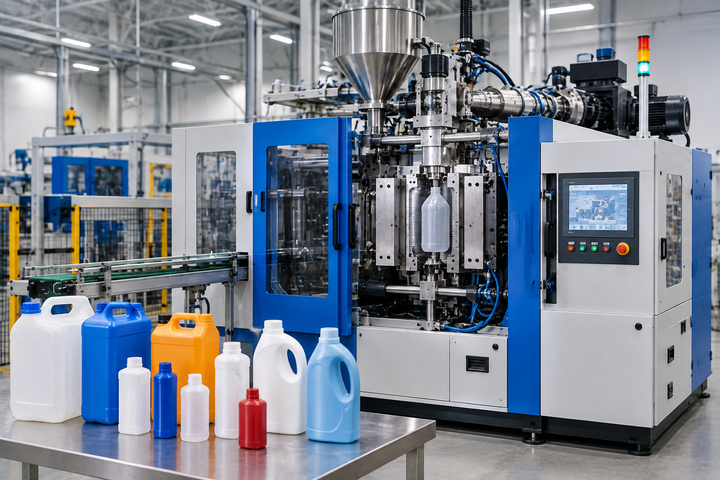
Extrusion Blow Molding Machine: Manufacturing Guide
Extrusion blow molding machines play a major role in modern plastic manufacturing.
They are widely used to produce hollow plastic products such as bottles, containers, tanks, drums, automotive reservoirs, and industrial packaging components.
The process combines plastic extrusion and air pressure molding to create lightweight yet durable hollow products. Because of its efficiency and versatility, extrusion blow molding remains one of the most widely used manufacturing methods in the plastics industry.
Understanding how these machines work, their components, production stages, and applications can help manufacturers, engineers, and industry professionals better understand this important production technology. Extrusion blow molding forms a hollow plastic tube called a parison, which is inflated inside a mold using compressed air until it takes the shape of the mold cavity.
Quick Facts About Extrusion Blow Molding Machines
| Feature | Description |
|---|---|
| Manufacturing Process | Hollow plastic product production |
| Main Material Types | HDPE, PP, PVC, PETG, LDPE |
| Primary Output | Bottles, containers, tanks, drums |
| Production Method | Extrusion and air inflation |
| Automation Level | Manual to fully automatic |
| Common Industries | Packaging, automotive, chemical, agriculture |
| Product Type | Hollow plastic components |
| Production Scale | Small to large-volume manufacturing |
What Is an Extrusion Blow Molding Machine?
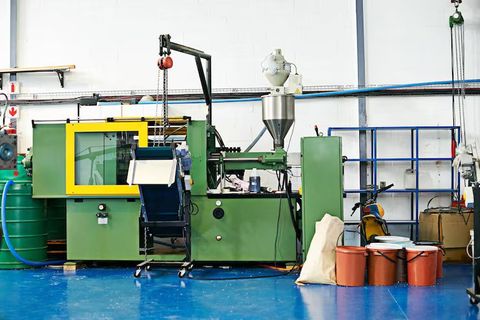
An extrusion blow molding machine is industrial equipment used to manufacture hollow plastic products. The machine melts plastic resin, forms a hollow tube called a parison, encloses it within a mold, and inflates it using compressed air. Once cooled, the finished product is removed and prepared for further processing.
This manufacturing process is particularly effective for creating containers, bottles, fuel tanks, industrial drums, and numerous hollow plastic products.
Understanding the Extrusion Blow Molding Process
The process begins with plastic pellets being fed into an extruder where they are heated and transformed into a molten material. The molten plastic is then shaped into a hollow tube known as a parison.
A mold closes around the parison, and compressed air inflates it against the mold walls. After cooling and solidification, the mold opens and the finished product is ejected.
Extrusion Blow Molding Machine Architecture
Understanding machine architecture helps explain how production takes place.
Raw Material Feeding System
The hopper stores plastic resin pellets and delivers them into the extrusion system.
Extrusion System
The extruder melts and plasticizes the material through a rotating screw and heated barrel.
Die Head System
The die head shapes molten plastic into a hollow tubular parison.
Mold Clamping Unit
The clamping unit closes the mold securely around the parison.
Blow Pin System
Compressed air enters through the blow pin to expand the parison.
Cooling System
Cooling channels remove heat and allow the product to solidify. Cooling is often the longest phase of the production cycle.
Control System
The control system manages temperatures, pressure, cycle timing, and production settings.
Main Components of an Extrusion Blow Molding Machine
| Component | Function |
|---|---|
| Hopper | Feeds raw material |
| Extruder Screw | Melts and conveys plastic |
| Barrel | Provides controlled heating |
| Die Head | Forms the parison |
| Mold | Creates product shape |
| Blow Pin | Supplies compressed air |
| Hydraulic System | Controls movement |
| Cooling System | Solidifies products |
| Control Panel | Manages machine settings |
| Conveyor System | Handles finished products |
Types of Extrusion Blow Molding Machines
Continuous Extrusion Machines
These machines continuously produce a parison during operation.
Intermittent Extrusion Machines
Material is accumulated and released at specific intervals.
Shuttle Machines
A shuttle system moves molds between extrusion and blowing stations.
Rotary Wheel Machines
Multiple molds rotate continuously to support high-volume production.
Multi-Layer Blow Molding Machines
These machines produce products with multiple material layers for specialized applications.
Step-by-Step Manufacturing Process
Step 1: Material Feeding
Plastic pellets enter the hopper and move into the extruder.
Step 2: Plastic Melting
The extruder heats and mixes the material into a homogeneous melt.
Step 3: Parison Formation
Molten plastic exits the die head and forms a hollow tube called a parison.
Step 4: Mold Closing
The mold closes around the parison and seals its lower end.
Step 5: Air Inflation
Compressed air inflates the parison against the mold cavity.
Step 6: Cooling
The product cools and solidifies while maintaining the mold shape.
Step 7: Product Ejection
The mold opens and the product is removed.
Step 8: Trimming
Excess material, known as flash, is trimmed and often recycled.
Production Cycle Overview
| Manufacturing Stage | Purpose |
|---|---|
| Material Feeding | Supply raw resin |
| Plasticizing | Melt plastic |
| Parison Formation | Create hollow tube |
| Mold Closing | Capture parison |
| Blowing | Form final shape |
| Cooling | Solidify product |
| Ejection | Remove product |
| Trimming | Finish component |
Materials Commonly Used
| Material | Common Applications |
|---|---|
| HDPE | Bottles, containers, tanks |
| PP | Packaging products |
| LDPE | Flexible containers |
| PVC | Industrial applications |
| Multi-Layer Materials | Barrier packaging |
| Engineering Polymers | Specialized industrial products |
HDPE is one of the most widely used materials in extrusion blow molding because of its strength and processability.
Capacity Comparison
| Machine Category | Typical Production Environment |
|---|---|
| Small Capacity | Specialty manufacturing |
| Medium Capacity | Regional production facilities |
| High Capacity | Large manufacturing plants |
| Multi-Cavity Systems | High-volume packaging production |
Advantages of Extrusion Blow Molding
Efficient Production
The process supports continuous manufacturing.
Hollow Product Manufacturing
Ideal for producing hollow plastic components.
Design Flexibility
Complex shapes can be produced efficiently.
Material Versatility
Compatible with many thermoplastic materials.
Scalability
Suitable for both small and large production volumes.
Large Part Manufacturing
Extrusion blow molding can produce larger hollow components than some alternative molding processes.
Manufacturing Challenges and Solutions
| Challenge | Practical Solution |
|---|---|
| Uneven Wall Thickness | Optimize parison control |
| Material Waste | Improve trimming recovery |
| Cooling Delays | Enhance cooling systems |
| Product Defects | Improve process monitoring |
| Parison Sagging | Use appropriate material selection |
| Cycle Variations | Maintain process consistency |
Parison control is important because excessive sagging can lead to uneven wall thickness and reduced product quality.
Quality Control Factors
Wall Thickness Consistency
Uniform wall thickness improves product reliability.
Surface Quality
Smooth surfaces indicate stable processing conditions.
Dimensional Accuracy
Products must conform to design specifications.
Leak Testing
Containers are often tested for air-tight performance.
Material Integrity
Proper processing helps maintain material properties.
Environmental Considerations
Material Recycling
Trimmed flash material can often be reprocessed and reused within manufacturing operations.
Energy Optimization
Modern machines focus on efficient energy utilization.
Resource Efficiency
Process improvements continue to reduce manufacturing waste.
Sustainable Manufacturing
Advanced controls help improve material utilization.
Industry Standards and Safety
Machine Safety Systems
Modern equipment includes safety doors, emergency stops, and protective mechanisms.
Temperature Monitoring
Controlled temperatures help ensure process stability.
Pressure Management
Air pressure systems must operate within specified ranges.
Operator Protection
Safety procedures help reduce workplace risks.
Equipment Maintenance
Routine inspections help support safe operation.
Maintenance Schedule
| Maintenance Task | Frequency | Purpose |
|---|---|---|
| Inspect Extruder Screw | Weekly | Maintain melting efficiency |
| Check Hydraulic System | Monthly | Ensure smooth operation |
| Inspect Mold Surfaces | Weekly | Maintain product quality |
| Clean Cooling Channels | Monthly | Improve cooling efficiency |
| Verify Air System | Monthly | Support consistent blowing |
| Review Controls | Periodically | Maintain accuracy |
Real-World Applications
Packaging Industry
Used for bottles, containers, and storage products.
Automotive Manufacturing
Produces fuel tanks, reservoirs, and ducts.
Agriculture
Manufactures chemical and water storage containers.
Consumer Products
Used for household and utility items.
Industrial Storage
Produces drums, tanks, and specialized containers.
Industry Application Comparison
| Industry | Common Products |
|---|---|
| Packaging | Bottles and containers |
| Automotive | Fuel tanks and reservoirs |
| Agriculture | Storage containers |
| Consumer Goods | Household products |
| Industrial Manufacturing | Drums and tanks |
Expert Insights
Manufacturing specialists often consider extrusion blow molding one of the most versatile methods for producing hollow plastic products. Success depends on balancing material selection, parison control, cooling efficiency, mold design, and process consistency.
Modern systems increasingly incorporate automation, advanced controls, and improved energy management to enhance production efficiency and product quality.
Future Trends and Industry Insights
Advanced Automation
Automated production systems continue expanding across manufacturing facilities.
Smart Process Monitoring
Sensors provide improved production visibility.
Multi-Layer Technology
Multi-layer products support advanced packaging applications.
Energy-Efficient Equipment
Manufacturers continue developing more efficient machinery.
Enhanced Quality Control
Modern inspection systems improve production consistency.
Frequently Asked Questions
What is an extrusion blow molding machine?
It is industrial equipment used to manufacture hollow plastic products through extrusion and air inflation.
What is a parison?
A hollow tube of molten plastic used during blow molding.
Which materials are commonly used?
HDPE, PP, LDPE, PVC, and other thermoplastics.
What products can be manufactured?
Bottles, containers, tanks, drums, and automotive components.
Why is cooling important?
Cooling allows the product to solidify and retain its final shape.
What is flash?
Excess plastic removed after molding.
What industries use extrusion blow molding?
Packaging, automotive, agriculture, industrial manufacturing, and consumer products.
What is a shuttle machine?
A machine where molds move between extrusion and blowing stations.
How is product quality maintained?
Through process control, inspection, leak testing, and maintenance.
What future developments are expected?
Greater automation, smarter monitoring systems, and improved efficiency.
Conclusion
Extrusion blow molding machines are a critical part of modern plastic manufacturing. They provide an efficient method for producing hollow products used across packaging, automotive, agricultural, industrial, and consumer sectors.
By understanding machine architecture, manufacturing stages, materials, quality control factors, maintenance requirements, and industry applications, manufacturers can better appreciate the capabilities of extrusion blow molding technology. As automation, monitoring systems, and energy-efficient designs continue to advance, extrusion blow molding is expected to remain a key manufacturing process for years to come.