Ultrasonic Sieves: Technology, Applications and Insights
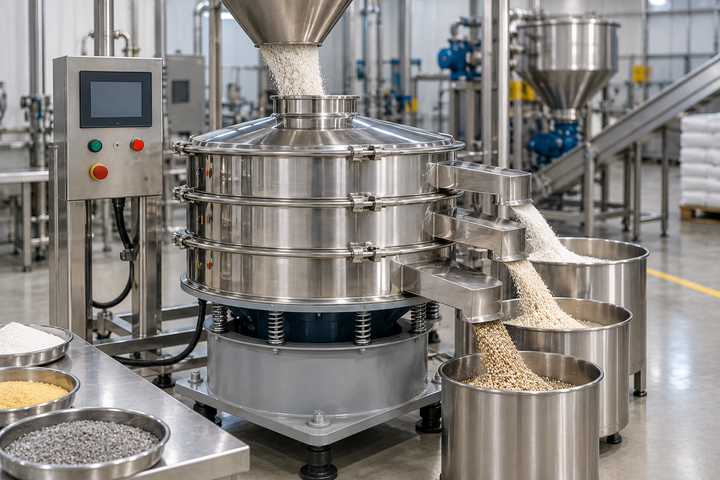
Ultrasonic sieves are advanced screening systems used in industries that handle fine powders, granules, and specialized materials.
They combine traditional sieving methods with ultrasonic vibration technology to improve material separation efficiency.
Conventional sieving can sometimes struggle with very fine particles because materials may clog the mesh surface or stick together. Ultrasonic sieves address this challenge by introducing high-frequency vibrations that help particles move more freely across the screen.
These systems are widely used in pharmaceutical manufacturing, food processing, chemical production, metal powder handling, battery material processing, and many other industrial applications where precision particle separation is important.
What Are Ultrasonic Sieves?
An ultrasonic sieve is a screening system that uses ultrasonic energy to enhance the movement of particles through a mesh screen.
The system generates high-frequency vibrations that are transmitted to the sieve mesh. These vibrations reduce particle friction, minimize mesh blockage, and improve material flow during screening operations.
As a result, ultrasonic sieves can process finer materials more effectively than many conventional screening systems.
Quick Facts About Ultrasonic Sieves
| Feature | Description |
|---|---|
| Technology Type | Ultrasonic-assisted screening |
| Primary Function | Fine particle separation |
| Frequency Range | High-frequency ultrasonic vibration |
| Common Materials | Powders, granules, specialty materials |
| Main Benefit | Reduced mesh blockage |
| Typical Industries | Pharmaceutical, food, chemical, metallurgy |
| Screening Precision | Suitable for fine particle processing |
| Operating Method | Vibratory screening enhancement |
Understanding the Concept
Traditional sieving relies on mechanical vibration to move material across a screen.
With ultrasonic technology, an additional ultrasonic frequency is introduced into the mesh. This creates microscopic vibrations that help separate particles and prevent them from sticking to the screen surface.
The result is improved screening efficiency, especially when working with:
- Fine powders
- Lightweight materials
- Sticky particles
- Electrostatic materials
- High-value specialty powders
How Ultrasonic Sieves Work
Step 1: Material Feeding
Material enters the screening surface through a controlled feed system.
Step 2: Mechanical Vibration
The sieve begins vibrating to move particles across the screen.
Step 3: Ultrasonic Energy Generation
An ultrasonic generator produces high-frequency electrical signals.
Step 4: Energy Conversion
A transducer converts electrical signals into ultrasonic vibrations.
Step 5: Mesh Excitation
The vibrations are transferred to the sieve mesh.
Step 6: Particle Separation
Fine particles pass through the mesh while oversized particles remain on the screen surface.
Ultrasonic Screening Process Overview
| Stage | Function |
|---|---|
| Material Feeding | Introduces material |
| Mechanical Vibration | Moves particles |
| Ultrasonic Generation | Creates high-frequency energy |
| Energy Transfer | Delivers vibration to mesh |
| Particle Separation | Sorts materials by size |
| Material Collection | Collects screened fractions |
Main Components of an Ultrasonic Sieve
| Component | Function |
|---|---|
| Screen Mesh | Separates particles |
| Ultrasonic Generator | Produces ultrasonic signals |
| Transducer | Converts energy into vibration |
| Resonance Ring | Distributes ultrasonic energy |
| Vibratory Motor | Provides mechanical motion |
| Frame Assembly | Supports equipment structure |
| Control System | Manages operation |
Ultrasonic Sieve Architecture
Feed Section
The feed section introduces material onto the screen surface.
Screening Surface
The mesh performs particle separation according to size.
Ultrasonic System
The generator and transducer create ultrasonic vibration.
Vibration System
Mechanical vibration assists material movement.
Collection Area
Separated material fractions are collected after screening.
Control Interface
Operators manage system settings and performance.
Types of Ultrasonic Sieves
Circular Ultrasonic Sieves
Widely used for fine powder processing.
Rotary Ultrasonic Sieves
Suitable for continuous industrial production.
Laboratory Ultrasonic Sieves
Used for research and material testing.
Industrial Ultrasonic Screening Systems
Designed for high-volume production environments.
Multi-Deck Ultrasonic Sieves
Provide multiple particle size classifications in a single process.
Ultrasonic Sieve Types Comparison
| Type | Typical Application |
|---|---|
| Circular | Fine powder screening |
| Rotary | Continuous processing |
| Laboratory | Testing and analysis |
| Industrial | Large-scale production |
| Multi-Deck | Multiple size separation |
Why Ultrasonic Technology Improves Screening
Reduced Mesh Blockage
High-frequency vibrations help keep mesh openings clear.
Improved Particle Flow
Particles move more freely across the screen surface.
Better Fine Powder Processing
Ultrasonic energy assists the separation of very small particles.
Enhanced Screening Accuracy
More consistent particle classification can be achieved.
Increased Throughput
Improved material movement may support higher processing efficiency.
Particle Size Separation Capabilities
| Material Type | Screening Suitability |
|---|---|
| Fine Powders | Excellent |
| Chemical Powders | High |
| Metal Powders | High |
| Food Ingredients | High |
| Pharmaceutical Powders | High |
| Specialty Materials | High |
Applications of Ultrasonic Sieves
Pharmaceutical Manufacturing
Used for screening active ingredients and powder blends.
Food Processing
Supports the classification of powdered food materials.
Chemical Production
Used for fine chemical powders and specialty compounds.
Metal Powder Processing
Important for additive manufacturing and powder metallurgy.
Battery Material Production
Assists with particle classification for battery materials.
Cosmetics Manufacturing
Used for fine powders in personal care products.
Industry Applications
| Industry | Common Use |
|---|---|
| Pharmaceutical | Powder classification |
| Food Processing | Ingredient screening |
| Chemical | Fine material separation |
| Metallurgy | Metal powder processing |
| Battery Manufacturing | Material grading |
| Cosmetics | Fine powder handling |
Benefits and Advantages
Higher Screening Efficiency
Ultrasonic energy improves particle movement.
Reduced Screen Blinding
Mesh openings remain clearer during operation.
Improved Product Quality
More consistent particle sizing can be achieved.
Better Processing of Fine Materials
Supports handling of difficult powders.
Enhanced Production Consistency
Provides reliable screening performance.
Flexible Industrial Applications
Suitable for many material types.
Environmental Considerations
Modern ultrasonic sieves can contribute to efficient material processing by improving separation effectiveness and reducing material losses.
Resource Efficiency
Improved screening accuracy may reduce unnecessary material waste.
Reduced Reprocessing
Accurate particle classification may minimize repeated screening operations.
Production Optimization
Efficient screening supports streamlined manufacturing workflows.
Industry Standards and Safety
Ultrasonic sieves used in industrial environments are generally designed according to applicable machinery, electrical, and operational safety requirements.
Electrical Safety
Systems include protected electrical components and control circuits.
Material Compatibility
Equipment materials are selected according to process requirements.
Equipment Protection
Industrial designs often include protective covers and safety features.
Process Reliability
Monitoring systems support consistent screening performance.
Common Challenges and Solutions
| Challenge | Practical Solution |
|---|---|
| Mesh Blockage | Use ultrasonic vibration |
| Material Agglomeration | Optimize vibration settings |
| Fine Powder Handling | Select appropriate mesh size |
| Throughput Variation | Maintain consistent feed rates |
| Particle Adhesion | Utilize ultrasonic assistance |
| Equipment Wear | Follow maintenance schedules |
Maintenance Schedule
| Maintenance Task | Frequency | Purpose |
|---|---|---|
| Inspect Mesh | Daily | Identify damage |
| Clean Screen Surface | Daily | Maintain efficiency |
| Check Generator | Weekly | Verify operation |
| Inspect Transducer | Monthly | Ensure vibration performance |
| Examine Connections | Monthly | Maintain reliability |
| System Inspection | Periodically | Evaluate overall condition |
Best Practices for Ultrasonic Sieves
Use Appropriate Mesh Sizes
Select mesh specifications based on particle requirements.
Maintain Consistent Feed Rates
Uniform feeding supports efficient separation.
Inspect Components Regularly
Routine inspections help maintain performance.
Monitor Ultrasonic Output
Proper vibration levels improve screening effectiveness.
Follow Maintenance Procedures
Scheduled maintenance supports long-term reliability.
Expert Insights
Screening specialists often consider ultrasonic sieving particularly valuable for fine powders that are difficult to process using conventional methods.
Industries handling pharmaceutical powders, specialty chemicals, battery materials, and metal powders frequently benefit from ultrasonic screening because the technology helps improve particle movement and reduce screen blockage.
Key Facts About Ultrasonic Sieves
- Ultrasonic sieves combine mechanical and ultrasonic vibration.
- They are commonly used for fine particle separation.
- High-frequency vibrations help reduce mesh blockage.
- The technology supports improved powder flow.
- Multiple industries rely on ultrasonic screening systems.
- Fine material processing is one of the primary applications.
Future Trends and Industry Insights
Advanced Control Systems
Future systems may include more intelligent process monitoring.
Automated Screening Operations
Automation continues to expand within manufacturing environments.
Enhanced Energy Management
Equipment efficiency remains a focus area.
Improved Material Handling
Future designs may support increasingly complex powders.
Smart Manufacturing Integration
Ultrasonic sieves may become more connected within modern production facilities.
Frequently Asked Questions
What is an ultrasonic sieve?
An ultrasonic sieve is a screening system that uses ultrasonic vibration to improve particle separation.
Why are ultrasonic sieves used?
They help process fine powders and reduce mesh blockage.
What industries use ultrasonic sieves?
Pharmaceutical, food, chemical, metallurgy, battery, and cosmetics industries.
How does ultrasonic vibration help screening?
It improves particle movement and keeps mesh openings clearer.
What materials can be screened?
Powders, granules, metal powders, food ingredients, and specialty materials.
What is screen blinding?
Screen blinding occurs when particles block mesh openings.
Can ultrasonic sieves process fine powders?
Yes, they are particularly effective for fine powder applications.
What is a transducer?
A transducer converts electrical energy into ultrasonic vibration.
Why is mesh selection important?
Mesh size determines particle separation accuracy.
What maintenance is required?
Routine inspections, cleaning, and component checks are commonly recommended.
Conclusion
Ultrasonic sieves represent an important advancement in particle separation technology. By combining traditional screening methods with high-frequency ultrasonic vibration, these systems help improve material flow, reduce mesh blockage, and enhance screening accuracy.
Their ability to process fine powders efficiently makes them valuable across pharmaceutical manufacturing, food processing, chemical production, metallurgy, battery materials, and other precision industries. As industrial processing continues to evolve, ultrasonic sieves are expected to remain a key technology for advanced material classification and screening applications.