Recycling Machinery Overview: Types, Working and Applications
Recycling machinery refers to industrial equipment used to collect, sort, process, separate, and transform waste materials into reusable raw materials.
These machines handle materials such as plastic, paper, cardboard, glass, metals, and electronic waste through mechanical operations, including shredding, crushing, compacting, washing, and separation.
Modern recycling facilities use combinations of specialized machines to prepare recovered materials for further processing and manufacturing. The equipment selected depends on the waste material, contamination level, required output quality, and intended recycling process.
Quick Facts About Recycling Machinery
The following table highlights the main characteristics of recycling machinery and its role in industrial waste processing.
Feature | Details |
|---|---|
Equipment Category | Industrial recycling and waste processing machinery |
Primary Purpose | Recover and process reusable materials |
Main Operations | Sorting, shredding, crushing, washing, separating, and compacting |
Common Materials | Plastic, metal, paper, cardboard, glass, and electronic waste |
Main Equipment | Shredders, crushers, granulators, balers, separators, and washing systems |
Processing Methods | Mechanical separation, size reduction, cleaning, and material recovery |
Common Industries | Manufacturing, packaging, construction, automotive, and waste management |
Output Materials | Recovered flakes, granules, bales, metal fractions, and recycled aggregates |
Automation Technologies | Sensors, conveyors, optical sorting, PLCs, and industrial control systems |
Key Selection Factors | Material type, processing capacity, contamination, and output requirements |
What Is Recycling Machinery?
Recycling machinery is a collection of industrial machines designed to process discarded materials and prepare them for reuse or further manufacturing. These machines perform different operations depending on the physical properties and composition of incoming waste.
For example, plastic recycling equipment converts discarded plastic products into flakes or pellets, while metal recycling machinery separates and processes ferrous and non-ferrous materials. Paper recycling systems use pulping, screening, and cleaning equipment to recover usable paper fibers.
A recycling facility may use individual machines or an integrated processing line. In a complete installation, materials typically move through several stages, starting with receiving and sorting and continuing through size reduction, cleaning, separation, and final material preparation.
The main objective is to produce recovered materials with suitable physical and quality characteristics for their next application.
Why Recycling Machinery Matters in Industrial Waste Processing
Industrial waste streams often contain different materials, sizes, shapes, and contamination levels. Processing these materials manually can be difficult, particularly when facilities handle large or continuous waste volumes.
Recycling machinery provides specialized mechanical operations that help facilities manage these materials systematically.
Its importance can be understood through several functions:
Material recovery: Separates reusable materials from mixed waste streams.
Waste volume reduction: Compresses or reduces the size of materials for easier handling and transportation.
Contamination removal: Uses washing, screening, and separation equipment to remove unwanted substances.
Processing consistency: Produces more uniform material sizes and fractions.
Industrial integration: Connects different processing stages through conveyors and automated control systems.
Resource conservation: Supports the recovery of materials that can replace some virgin raw materials in manufacturing.
The effectiveness of recycling machinery depends on how well the equipment matches the incoming material and the quality requirements of the recovered output.
How Does Recycling Machinery Work?
Recycling machinery generally operates through a sequence of material handling and processing stages. The exact arrangement varies according to the waste stream. A plastic recycling line, for example, requires different equipment from a metal recovery or paper recycling facility.
The following stages explain a typical mechanical recycling workflow.
1. Material Collection and Receiving
The process begins when discarded materials arrive at a recycling facility. Incoming waste may come from manufacturing plants, commercial facilities, construction sites, households, or industrial collection systems.
Receiving equipment includes loading hoppers, tipping areas, feeding conveyors, and storage containers.
The incoming material is inspected to identify its composition and determine whether it is suitable for the intended processing line.
2. Sorting and Material Identification
Sorting equipment separates waste according to material type, size, shape, color, or physical properties.
Depending on the facility, sorting may involve manual inspection, magnetic separation, optical identification, or automated air-based systems.
The purpose is to direct different material fractions toward the appropriate processing equipment.
3. Shredding and Size Reduction
Shredders, crushers, and granulators reduce large waste materials into smaller pieces.
This operation improves material handling and prepares waste for subsequent cleaning, separation, or reprocessing.
The required particle size depends on the material and the next processing stage.
4. Washing and Contamination Removal
Some recycling streams require washing to remove dirt, labels, adhesives, oils, food residues, and other unwanted substances.
Washing systems may use water tanks, friction washers, rinsing units, or specialized cleaning equipment.
Not every recycling process requires wet cleaning. Clean industrial scrap, for example, may move directly to size reduction or material separation.
5. Separation and Material Recovery
Separation equipment divides processed waste into different material fractions.
Magnetic separators recover ferrous metals, eddy current separators help separate non-ferrous metals, and density-based systems separate materials according to their behavior in a liquid or air stream.
Optical sorting equipment can identify selected materials using sensors and controlled ejection mechanisms.
6. Drying and Final Processing
After washing, materials may pass through mechanical or thermal drying equipment to reduce moisture.
Depending on the recycling stream, further processing may include extrusion, pelletizing, baling, melting, pulping, or material conditioning.
The final output is prepared for storage, transportation, or use in manufacturing.
The following table summarizes the main processing stages.
Processing Stage | Machinery Used | Main Function |
|---|---|---|
Receiving | Hoppers and conveyors | Accept and transport incoming waste |
Sorting | Optical and magnetic separators | Identify and separate materials |
Size Reduction | Shredders and crushers | Reduce material dimensions |
Cleaning | Washing systems | Remove contamination |
Separation | Air, density, and metal separators | Recover different material fractions |
Drying | Centrifugal and thermal dryers | Reduce moisture |
Final Processing | Extruders, balers, and pelletizers | Prepare recovered materials |
Storage | Bins and material handling systems | Organize processed output |
Main Types of Recycling Machinery
Recycling machinery is classified according to its primary processing function and the materials it handles. Some machines are used across multiple recycling industries, while others are designed for specific waste streams.
1. Industrial Recycling Shredders
Industrial shredders are size-reduction machines used to break large waste materials into smaller pieces. They commonly feature rotating shafts equipped with cutting blades or shredding elements.
Single-shaft, dual-shaft, and multi-shaft configurations are used for different material characteristics and processing requirements.
Main characteristics:
Processes bulky and irregular waste materials.
Reduces material dimensions for downstream equipment.
Available in different shaft and cutting configurations.
Can handle selected plastics, tires, wood, and industrial scrap.
Typical applications: Plastic recycling, tire recycling, electronic waste processing, and industrial waste management.
2. Recycling Crushers
Recycling crushers reduce materials through compression, impact, or other crushing mechanisms. They are commonly used for rigid materials that require size reduction before sorting or further processing.
Jaw crushers, impact crushers, and specialized industrial crushing systems are used depending on material properties.
Main characteristics:
Processes rigid and relatively hard materials.
Reduces large pieces into smaller fractions.
Supports material preparation for screening and separation.
Available in different crushing configurations.
Typical applications: Concrete recycling, glass processing, mineral recovery, and construction waste management.
3. Plastic Recycling Granulators
Granulators use rotating cutting blades and stationary knives to convert plastic scrap into smaller, more uniform particles.
A screen controls the approximate size of the discharged material. Granulators are commonly used after primary shredding or for processing relatively manageable plastic scrap.
Main characteristics:
Produces plastic flakes or granules.
Supports controlled particle-size reduction.
Handles selected rigid and flexible plastic materials.
Prepares plastic for washing and extrusion.
Typical applications: Injection molding waste recovery, plastic bottle processing, packaging waste recycling, and manufacturing scrap recovery.
4. Recycling Balers and Compactors
Balers compress recyclable materials into compact bundles called bales. Compactors reduce the volume of waste without necessarily producing tied bales.
Hydraulic systems are commonly used to generate the compression force required for processing bulky materials.
Main characteristics:
Reduces material volume.
Improves storage and handling efficiency.
Supports organized material transportation.
Available in vertical and horizontal configurations.
Typical applications: Cardboard recycling, paper processing, plastic film recovery, aluminum can recycling, and distribution centers.
5. Recycling Sorting Machines
Sorting machines separate mixed waste into individual material categories. Their operating principles depend on the physical or chemical properties of the materials being processed.
Common technologies include optical sorting, magnetic separation, eddy current separation, and air classification.
Main characteristics:
Separates different material fractions.
Supports automated material identification.
Can improve the consistency of recovered materials.
Integrates with conveyors and processing lines.
Typical applications: Municipal recycling facilities, plastic sorting plants, metal recovery operations, and packaging waste processing.
6. Industrial Recycling Washing Machines
Industrial washing machines clean recyclable materials by removing dirt, labels, adhesives, oils, and other contaminants.
Plastic recycling facilities may use friction washers, hot washing systems, float-sink tanks, and rinsing equipment.
Main characteristics:
Removes unwanted surface contamination.
Supports material separation through density differences.
Prepares recovered materials for further processing.
Can operate as part of integrated washing lines.
Typical applications: PET bottle recycling, plastic film processing, industrial container recovery, and packaging waste treatment.
7. Recycling Dryers
Recycling dryers remove moisture from materials after washing or other wet processing operations.
Centrifugal dryers use mechanical rotation to remove water, while thermal dryers use heated air or another controlled heating method.
Main characteristics:
Reduces residual moisture.
Prepares materials for extrusion or other processing.
Supports consistent downstream material handling.
Available in mechanical and thermal configurations.
Typical applications: Plastic flake processing, textile recycling, washed plastic films, and industrial material recovery.
8. Plastic Recycling Extruders and Pelletizers
Extruders melt and process suitable thermoplastic materials through a heated barrel and rotating screw. The molten material passes through a die and may then be converted into pellets.
Pelletizing systems produce small, relatively uniform plastic granules for subsequent manufacturing operations.
Main characteristics:
Processes compatible thermoplastic materials.
Supports melt filtration and material blending.
Converts recovered plastic into reusable feedstock.
Can integrate with strand or die-face pelletizing systems.
Typical applications: Recycled plastic granule production, packaging materials, plastic component manufacturing, and polymer processing.
Recycling Machinery Type Comparison
Different recycling machines perform different functions within an industrial processing line. The following comparison explains their primary roles.
Machinery Type | Main Working Principle | Common Materials | Primary Output |
|---|---|---|---|
Industrial Shredder | Cutting and shearing | Plastic, tires, wood, mixed waste | Shredded pieces |
Recycling Crusher | Compression or impact | Concrete, glass, rigid materials | Crushed fragments |
Plastic Granulator | Blade cutting | Plastic scrap | Flakes or granules |
Baler | Hydraulic compression | Paper, cardboard, plastics, metals | Compressed bales |
Sorting Machine | Optical, magnetic, or physical separation | Mixed recyclables | Separated fractions |
Washing Machine | Mechanical cleaning and water circulation | Plastic and selected recyclables | Cleaned material |
Recycling Dryer | Centrifugal or thermal moisture removal | Washed plastic and other materials | Dried material |
Extruder and Pelletizer | Melting, extrusion, and pellet formation | Thermoplastics | Recycled plastic pellets |
Recycling Machinery vs Waste Management Equipment
Recycling machinery and waste management equipment are related, but their functions are not identical. Waste management equipment covers a wider range of activities, including waste collection, transportation, storage, treatment, and disposal.
Recycling machinery focuses specifically on recovering and preparing materials for reuse.
Comparison Factor | Recycling Machinery | Waste Management Equipment |
|---|---|---|
Main Purpose | Recover reusable materials | Handle and manage waste |
Primary Activities | Sorting, shredding, washing, and separation | Collection, transportation, treatment, and disposal |
Common Equipment | Shredders, granulators, separators, and balers | Compactors, collection vehicles, containers, and treatment systems |
Main Output | Recovered material fractions | Managed or treated waste |
Common Facilities | Material recovery and recycling plants | Waste collection and treatment facilities |
Some equipment belongs to both categories. For example, a waste compactor may be used in a general waste facility or as part of a recycling operation.
Main Components of Recycling Machinery
Although recycling equipment varies by design, many industrial systems contain similar mechanical, electrical, and material-handling components.
The following table explains the main components found in typical recycling machines.
Component | Function | Importance |
|---|---|---|
Feeding Hopper | Receives incoming material | Controls material entry |
Conveyor System | Moves materials between stages | Supports continuous processing |
Cutting Blades | Reduce material size | Enable shredding and granulation |
Rotor and Shaft | Transfer rotational movement | Drive mechanical processing |
Electric Motor | Supplies mechanical power | Operates moving components |
Hydraulic System | Produces controlled mechanical force | Supports baling and compression |
Screening Unit | Controls discharged particle size | Separates material by dimensions |
Separation Unit | Divides different material fractions | Improves material recovery |
Control Panel | Manages machine functions | Supports monitoring and operation |
Safety Guards | Restrict access to hazardous areas | Protect operators from moving components |
Not every machine contains all these components. A baler, for example, relies heavily on hydraulic compression, while an optical sorter requires sensors, processing electronics, and controlled ejection mechanisms.
Applications of Recycling Machinery Across Industries
Recycling machinery supports material recovery in several industrial sectors. The equipment configuration depends on the type of waste generated and the material characteristics required for subsequent manufacturing.
1. Plastic Manufacturing and Packaging
Plastic manufacturing facilities use recycling machinery to process production scrap, rejected components, packaging waste, and post-consumer plastics.
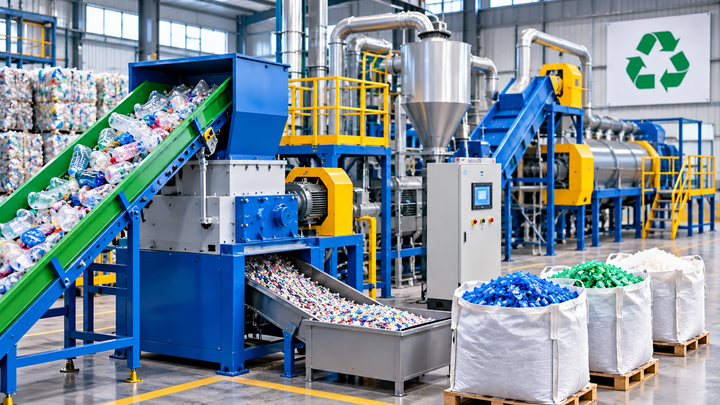
Shredders and granulators reduce plastic waste into smaller pieces, while washing systems remove contamination. Extruders and pelletizers can then convert suitable thermoplastic materials into reusable granules.
Common applications include:
PET bottle recycling.
HDPE container processing.
Plastic film recovery.
Injection molding scrap processing.
Packaging material recycling.
2. Metal Processing and Automotive Industries
Metal recycling facilities use specialized equipment to recover steel, aluminum, copper, and other metals from industrial and discarded products.
Shredders reduce bulky scrap, magnetic separators recover ferrous metals, and eddy current separators help separate non-ferrous metal fractions.
Automotive recycling facilities also use metal recovery systems to process selected vehicle components and scrap materials.
3. Paper and Cardboard Manufacturing
Paper recycling facilities process used paper, cardboard, packaging materials, and selected fiber-based waste.
Balers compress collected paper for handling, while pulpers mix suitable paper materials with water to produce a fiber suspension. Screening and cleaning equipment remove unwanted contaminants before the recovered fibers move to papermaking operations.
Common applications include corrugated cardboard recovery, newspaper recycling, and packaging paper production.
4. Construction and Demolition Waste Processing
Construction and demolition activities generate concrete, bricks, asphalt, wood, metals, and other discarded materials.
Recycling facilities use crushers, screens, conveyors, and magnetic separators to process suitable waste fractions.
Recovered concrete and masonry materials may be processed into recycled aggregates for selected construction applications, subject to quality requirements.
5. Glass Recycling
Glass recycling facilities use specialized crushing, screening, and sorting equipment to process discarded glass containers and other suitable glass waste.
Crushers reduce glass into fragments known as cullet. Screening equipment separates material by size, while sorting systems remove contaminants such as metals, ceramics, and unwanted glass fractions.
Recovered cullet can be used as feedstock in suitable glass manufacturing processes.
6. Electronic Waste Recycling
Electronic waste contains a mixture of metals, plastics, circuit boards, cables, and other components.
E-waste recycling facilities use dismantling equipment, shredders, granulators, magnetic separators, eddy current separators, and specialized sorting systems.
The objective is to recover valuable material fractions while managing hazardous components and contamination appropriately.
7. Tire and Rubber Recycling
Tire recycling systems process discarded tires into smaller rubber particles and recover selected steel and textile components.
Typical equipment includes tire shredders, steel separation systems, granulators, and rubber grinding machines.
Recovered rubber granules may be used in selected flooring materials, molded products, and other industrial applications depending on material quality.
Common Recycling Machinery Challenges and Solutions
Recycling equipment operates under demanding conditions because incoming waste can contain mixed materials, contamination, moisture, and abrasive substances.
The following table outlines common operational challenges and practical approaches to managing them.
Common Challenge | Potential Impact | Recommended Solution |
|---|---|---|
Mixed material composition | Poor separation quality | Improve pre-sorting and material identification |
Equipment blockages | Processing interruptions | Use suitable feeding systems and approved clearing procedures |
Blade and component wear | Reduced processing efficiency | Inspect and replace worn components |
Excessive contamination | Lower recovered material quality | Improve washing and separation stages |
Inconsistent particle size | Downstream processing difficulties | Select suitable cutting systems and screen sizes |
High moisture content | Extrusion and storage problems | Use appropriate drying equipment |
Dust generation | Poor working conditions and equipment contamination | Install suitable dust extraction systems |
Electrical or mechanical faults | Unplanned interruptions | Follow preventive maintenance procedures |
Incorrect machine selection | Poor processing performance | Match equipment specifications to the waste stream |
How to Choose Recycling Machinery
Selecting recycling machinery requires a clear understanding of the incoming material, processing requirements, and intended output. A machine designed for plastic film may not be appropriate for rigid plastic scrap or metal waste.
The following factors help guide equipment selection.
Selection Factor | What to Evaluate | Why It Matters |
|---|---|---|
Material Type | Plastic, metal, paper, glass, or mixed waste | Determines machine design |
Material Condition | Moisture, contamination, and material shape | Influences processing requirements |
Processing Capacity | Required material throughput | Helps determine machine size |
Output Size | Required flakes, granules, or fragments | Determines cutting and screening configuration |
Separation Requirements | Magnetic, optical, air, or density separation | Influences recovery quality |
Automation Level | Manual, semi-automatic, or automated operation | Determines control and labor requirements |
Energy Requirements | Electrical and hydraulic power | Supports facility planning |
Installation Space | Machine dimensions and process layout | Affects plant arrangement |
Maintenance Needs | Blade replacement, cleaning, and component access | Influences operating reliability |
Output Quality | Purity, moisture, and material consistency | Determines downstream suitability |
For example, a plastic recycling facility may require a shredder, washing system, density separator, dryer, and extruder. A cardboard recycling facility may primarily need sorting conveyors, balers, and suitable material-handling equipment.
Equipment selection should therefore begin with a material assessment and a defined output specification rather than choosing machines based only on their processing capacity.
Limitations of Recycling Machinery
Recycling machinery supports material recovery, but it cannot process every waste stream in the same way. Equipment performance depends on the physical properties, composition, contamination, and condition of incoming materials.
Some important limitations include:
Material compatibility: Certain machines are designed for specific materials and may not handle mixed waste effectively.
Contamination: Food residues, adhesives, chemicals, and incompatible materials can affect processing quality.
Material degradation: Repeated mechanical and thermal processing can change the properties of some materials, particularly polymers.
Energy requirements: Shredding, crushing, washing, drying, and extrusion require energy.
Water consumption: Wet recycling processes require water management and appropriate wastewater treatment.
Maintenance requirements: Cutting blades, screens, bearings, and other components experience wear during operation.
Residual waste: Some incoming materials cannot be recovered economically or technically through the selected process.
Output limitations: Recovered materials may not meet the quality requirements of every manufacturing application.
These limitations make proper material characterization, process design, and quality control essential for successful recycling operations.
Recycling Machinery Industry Standards and Safety Considerations
Industrial recycling machinery contains rotating shafts, cutting blades, conveyors, hydraulic systems, electrical equipment, and other potentially hazardous components. Appropriate safety design and operating procedures are therefore necessary.
Several established standards are relevant to machinery design and industrial safety.
ISO 12100: Safety of Machinery – General Principles for Design – Risk Assessment and Risk Reduction
ISO 12100 provides a framework for identifying machinery hazards, assessing risks, and implementing appropriate risk-reduction measures during equipment design.
It is relevant to shredders, crushers, balers, conveyors, and other recycling machines.
IEC 60204-1: Safety of Machinery – Electrical Equipment of Machines
IEC 60204-1 addresses electrical equipment used in machinery. It covers relevant electrical design and control considerations for industrial equipment.
ISO 13849-1: Safety of Machinery – Safety-Related Parts of Control Systems
ISO 13849-1 addresses the design and integration of safety-related control system components. It is relevant when developing protective control functions for recycling equipment.
ISO 13850: Safety of Machinery – Emergency Stop Function – Principles for Design
ISO 13850 covers principles for designing emergency-stop functions in machinery. Its requirements are relevant to equipment where emergency stopping is part of the risk-reduction strategy.
Important Operational Safety Practices
In addition to applicable standards, recycling facilities should establish appropriate operating procedures.
Keep protective guards installed around hazardous moving components.
Use suitable emergency-stop arrangements.
Train operators to recognize machine hazards.
Isolate electrical, hydraulic, and pneumatic energy before maintenance.
Follow approved lockout and isolation procedures.
Never clear blockages while equipment is running.
Inspect safety devices and protective enclosures regularly.
Use appropriate dust and noise control measures.
Maintenance and safety procedures should be based on the machine manufacturer's instructions and a site-specific risk assessment.
Recycling Machinery Maintenance Best Practices
Regular maintenance helps maintain equipment performance, reduce unexpected interruptions, and identify developing mechanical problems.
Different machines require different maintenance activities, but several practices apply across most recycling facilities.
Inspect Cutting Blades and Rotating Components
Shredders, crushers, and granulators depend on cutting components to process materials effectively. Inspect blades, rotors, shafts, and associated fasteners for wear, damage, and alignment problems.
Check Bearings and Drive Systems
Bearings, belts, gears, and couplings support mechanical movement. Monitor their operating condition and follow the manufacturer's lubrication and replacement instructions.
Maintain Hydraulic Systems
Balers and other hydraulic machines require regular inspection of hoses, seals, connections, fluid condition, and hydraulic components.
Clean Conveyors and Feeding Systems
Remove accumulated material from suitable cleaning areas and inspect conveyor belts, rollers, and feeding mechanisms for damage or misalignment.
Inspect Electrical and Control Systems
Check electrical connections, control panels, sensors, and protective devices according to approved maintenance procedures.
Monitor Washing and Drying Equipment
Inspect water circulation systems, filters, pumps, tanks, and drying components. Remove accumulated contamination and verify that the equipment performs its intended function.
Maintain Maintenance Records
Document inspections, component replacements, breakdowns, and maintenance activities. These records help identify recurring problems and support equipment planning.
Future Trends in Recycling Machinery Technology
Recycling machinery continues to develop through improvements in automation, material identification, process monitoring, and equipment integration.
Several developments are influencing modern recycling facilities.
AI-Based Material Identification
Artificial intelligence and advanced sensor systems are being used in selected sorting applications to recognize material characteristics and improve automated separation decisions.
These technologies can support the identification of complex waste streams, although their performance depends on material presentation and system configuration.
Advanced Optical Sorting Systems
Optical sorting equipment uses technologies such as near-infrared sensing, color detection, and other identification methods to separate selected materials.
Improvements in sensor technology and sorting controls are expanding the range of materials that automated facilities can identify.
Automated Recycling Production Lines
Modern recycling facilities increasingly integrate conveyors, shredders, separators, washing systems, and material-handling equipment into coordinated production lines.
Programmable logic controllers and industrial monitoring systems help manage equipment sequences and identify operating problems.
Improved Plastic Recycling Technology
Developments in washing, filtration, extrusion, and material conditioning are supporting improved recovery of suitable plastic waste streams.
Advanced mechanical recycling processes also use additional purification stages to improve the quality of recovered polymer materials.
Industrial Monitoring and Predictive Maintenance
Sensors and equipment monitoring systems can track vibration, temperature, motor conditions, and other operating parameters.
This information can help maintenance teams identify abnormal equipment behavior and plan inspections before certain component failures occur.
Frequently Asked Questions About Recycling Machinery
1. What is recycling machinery used for?
Recycling machinery is used to process discarded materials into reusable material fractions. It performs operations such as sorting, shredding, crushing, washing, separating, drying, and compacting.
2. What are the main types of recycling machinery?
The main types include industrial shredders, crushers, granulators, balers, sorting machines, washing systems, dryers, extruders, and pelletizers. Each machine performs a specific function within a recycling process.
3. How does industrial recycling machinery work?
Industrial recycling machinery works through a sequence of material handling and processing operations. Waste is received, sorted, reduced in size, cleaned, separated, and prepared for further manufacturing or recovery.
4. What machines are used in plastic recycling?
Plastic recycling commonly uses sorting conveyors, shredders, granulators, washing machines, density separators, dryers, extruders, and pelletizers. The exact equipment arrangement depends on the plastic type and required output.
5. What is the difference between a recycling shredder and a granulator?
A shredder generally performs primary size reduction and handles larger or bulkier waste materials. A granulator uses cutting blades and a sizing screen to produce smaller, more uniform particles.
6. What is a recycling baler?
A recycling baler is a machine that compresses recyclable materials into compact bundles called bales. It is commonly used for cardboard, paper, plastic film, and selected metal waste.
7. Which industries use recycling machinery?
Recycling machinery is used in plastic manufacturing, metal processing, automotive recycling, paper production, construction waste processing, glass recovery, electronic waste recycling, and tire recycling.
8. What factors affect recycling machinery selection?
Important factors include material type, contamination level, required processing capacity, output size, separation requirements, available installation space, energy consumption, and maintenance requirements.
9. What is the difference between a recycling crusher and a shredder?
A recycling crusher typically reduces rigid materials through compression or impact, while a shredder uses cutting and shearing actions to process waste into smaller pieces. Their suitability depends on material properties and the intended processing stage.
10. How can recycling machinery performance be maintained?
Performance can be supported through regular inspections, blade maintenance, lubrication, hydraulic system checks, conveyor cleaning, electrical inspections, and timely replacement of worn components. Maintenance should follow the equipment manufacturer's recommendations.
Conclusion
Recycling machinery combines specialized industrial equipment to transform discarded materials into reusable resources. Shredders, crushers, granulators, balers, sorting systems, washing machines, dryers, and extruders each perform specific functions within the recycling process. Their applications extend across plastic manufacturing, metal recovery, paper production, construction, glass processing, and electronic waste management. Selecting suitable machinery requires evaluating material characteristics, processing capacity, contamination levels, and output requirements. With improvements in automated sorting, industrial monitoring, and mechanical processing, recycling machinery continues to support more organized and efficient material recovery operations.